SC LIVINGJUMBO INDUSTRY S.A. este producator de saci mari de rafie (polipropilena) tip big bags (jumbo bags) cu capacitate de incarcare intre 250 si 2000 kg in diverse variante constructive si dimensionale: saci cu un maner, saci cu doua manere, saci cu 4 manere (chingi de manipulare). Firma noastra va ofera SOLUTII complete pentru ambalarea, depozitarea si transportul marfurilor vrac de tipul: produse chimice granulare sau pulverulente, produse ceramice, materiale de constructii, produse agricole, produse alimentare, materiale reciclabile, etc.
Sistemul Integrat de Management Calitate (ISO 9001) - Mediu (ISO 14001) - Siguranta Alimentului (ISO 22000 - HACCP) constituie o garantie in plus ca ati ales FURNIZORUL POTRIVIT pentru AMBALAREA PRODUSELOR DVS.
Gama variata de produse, portofoliul de clienti si parteneri, impreuna cu vasta experienta in domeniu va asigura:
calitate superioara;
rentabilitate;
solutii inovatoare la timp
in scopul indeplinirii si chiar depasirii asteptarilor dumneavoastra legate de solutii de ambalare.
De ce Livingjumbo Industry?
Pentru ca suntem pe deplin convinsi ca cel mai important actionar al nostru este CLIENTUL!
In calitate de producator de saci tip big bags reciclabili, Livingjumbo Industry S.A. a dovedit responsabilitate deplina in ceea ce priveste fiecare aspect al productiei, incepand de la stadiile procesului de fabricatie si testare a calitatii, astfel incat clientii nostri potentiali sa fie asigurati ca beneficiaza de cele mai bune solutii in materie de ambalare. Acordarea unei atentii deosebite calitatii ne-a asigurat inca de la inceput un portofoliu impresionant de clienti atat pe plan intern, cat si extern.
Prezenta in tari precum: Franta, Olanda, Belgia, Norvegia, Germania, Italia, Spania sau Grecia este asigurata in mod direct (livrari catre utilizatori finali), cat si indirect (prin intermediul comisionarilor, distribuitorilor sau camerelor de comert).
Indiferent de canalul de distributie folosit, LIVINGJUMBO INDUSTRY asigura atat calitatea produselor sale, cat si livrarea rapida - abilitati care ne permit mentinerea si chiar cresterea cotei de piata si a portofoliului de clienti.
Construiti in conformitate cu necesitatile clientilor, sacii BIG BAGS au o gama larga de aplicatii in practica, fiind utilizati pentru ambalarea de produse: chimice (ingrasaminte, soda, uree), produse agricole (seminte, cereale, furaje), produse alimentare (granulare sau pulberi - sare, zahar, cafea etc), minereuri, materiale de constructii (nisip, var, ciment, moloz), materiale reciclabile (polistiren, granule PP, PE, PVC, hartie, lemn, plastic, feroase si neferoase etc).
Livingjumbo Industry S.A. si-a inceput activitatea in Septembrie 2002 cu scopul unic de a creste calitatea sacilor tip big bags, ajungand la raportul optim intre calitate-pret.
Investitie 100% privata, Livingjumbo Industry S.A. a fost infiintata ca o continuare normala a investitiilor in sacii PP mici (saci din polipropilena cu capacitate de 25-50 kg), localizata in acelasi oras.
Echipele de conducere si de control a calitatii, precum si cea mai parte a angajatilor au fost selectionate din cadrul unor experimentati si talentati lucratori, cei mai multi dintre acestia venind din sectorul de productie al sacilor tip big bags al fostei companii cu capital de stat - Romcarbon S.A. Buzau.
Cercetarea de piata a fost realizata cu aproape un an inainte de infiintare cu precadere in tari vest-europene, dar si in Romania, bineinteles.
Inca de la inceput am procedat la prezentarea companiei prin publicarea tipurilor de big bags pe care ii producem si distribuim (cu capacitate cuprinsa intre 100-2000 kg), cu specificarea posibilitatilor tehnice si trimiterea de oferte si mostre pentru testare.
In calitate de producator de saci tip big bags 100% reciclabili, Livingjumbo Industry S.A. a dovedit responsabilitate deplina in ceea ce priveste fiecare aspect al productiei, incepand de la stadiile procesului de fabricatie si testare a calitatii, astfel incat clientii nostri potentiali sa fie asigurati ca beneficiaza de cele mai bune solutii in materie de ambalare.
Acordarea unei atentii deosebite calitatii ne-a asigurat inca de la inceput un portofoliu impresionant de clienti atat pe plan intern, cat si extern. Cooperarea permanenta intre departamentele comercial si de productie a oferit clientilor nostri cele mai bune sugestii si alternative de achizitie in conditiile in care partenerii nostri nu au avut intotdeauna cea mai clara imagine vis-à-vis de necesitatile lor in domeniul ambalarii.
Livingjumbo Industry S.A. poate asigura o comunicare rapida si coerenta in diferite limbi de circulatie internationala: Engleza, Franceza, Germana, Italiana, Spaniola (fiecare cerere de oferta primeste raspunsul nostru in cateva ore, iar in cazuri exceptionale in maxim 24 de ore).
Dimensiunile calitatii produselor marca Livingjumbo Industry S.A. includ:
Performanta
principala caracteristica a sacilor tip big bags - respectam cu strictete specificatiile constructive furnizate de clientii nostri (dimensiuni, specificatii tehnice - greutate specifica, capacitate de incarcare, stabilizare UV, imprimare, ambalare, etc.).
Conformitate
comportament al sacilor nostri conform cu asteptarile clientilor in timpul proceselor de transport, incarcare, manipulare si stocare - ne asiguram intodeauna ca solutia de ambalare oferita clientilor este cea mai buna in corespondenta cu necesitatile acestora;
Siguranta
risc de accidentare (rezistenta chingilor/manerelor de sustinere si a tesaturii de polipropilena in timpul operatiunilor de incarcare, manipulare cu stivuitoare) - Livingjumbo Industry S.A. asigura un factor de siguranta de 5:1 si, la cererea clientilor, un factor de siguranta de 6:1.
Incredere
oferim calitate constanta a tuturor livrarilor catre partenerii nostri.
Durabilitate
durata de viata utila a produselor - intrucat nu facem compromisuri in ceea ce priveste selectia celor mai bune materii prime si materiale utilizate in procesul de productie, sacii nostri tip big bags sunt durabili, durata de "viata utila" a acestora depasind asteptarile tehnice.
Estetica
aspect foarte placut al tesaturii de polipropilena din care sunt confectionati sacii, linii de coasere drepte, imprimare de calitate a logo-urilor/emblemelor/etichetelor clientilor.
Optiuni suplimentare
caracteristici speciale - de exemplu, putem folosi la cerere coasere cu snur anti-praf pentru saci PP speciali.
Garantie
indirecta exprimata prin evaluare indirecta a calitatii - sustinuta de certificatul aferent Standardului de Calitate SR EN ISO 9001:2001, precum si de certificatele obtinute de la Institutul German Labordata pentru sacii UN bags (saci utilizati pentru transportul substantelor periculoase), Livingjumbo Industry S.A. este membru activ al EATP (European Association for Textile Polyolefins) si al asociatiei romane de profil ASPAPLAST.
Livrari rapide
perioada de timp dintre momentul primirii comenzilor de la client si cel al livrarii marfurilor este foarte scurta. Compania noastra satisface in mod deosebit necesitatile clientilor care prefera sa isi mentina un nivel minim sau zero al stocurilor (livrari JIT = "just-in-time"), avand avantajul localizarii apropiate fata de orice destinatie europeana.
Asistenta
dupa livrare asistenta acordata clientilor, rezolvarea cu success a posibilelor plangeri si verificarea continua a nivelului de satisfactie a partenerilor - toate acestea sunt realizabile urmarind proceduri speciale specifice Sistemului de Management al Calitatii. Periodic sunt transmise chestionare de control a satisfactiei clientilor ale caror rezultate sunt utilizate in scopul imbunatatirii abilitatii firmei de a fi competitiva pe piata specifica.
Octombrie 2002 a fost prima luna cand sacii nostri tip big bags cu 1 si 4 manere au penetrat piata europeana, fiind utilizati pentru o serie de aplicatii in industria si transportul marfurilor vrac: industria materialelor de constructii, industria alimentelor granulare, industria chimica, fertilizatori, agricultura, industria constructiilor, a reciclarii, ca sa numim doar o parte din domeniile catre care se adreseaza sacii de tip big bags.
Productia de saci realizata a fost livrata intr-o semnificativa proportie clientilor europeni (75%), restul (25%) fiind destinata pietei autohtone.
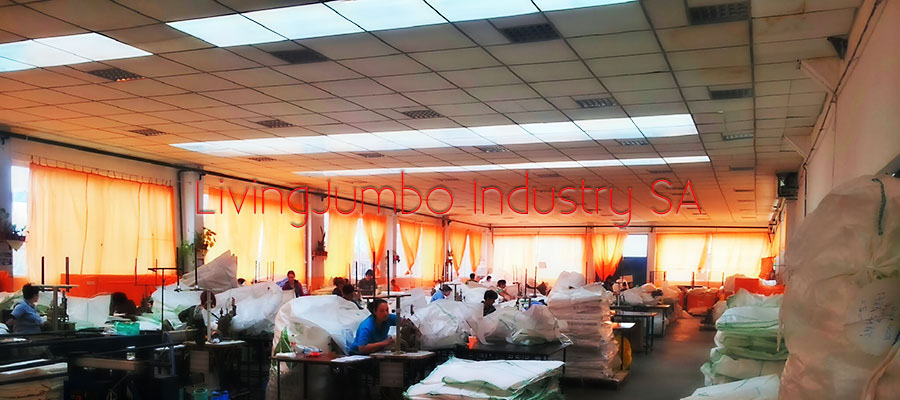
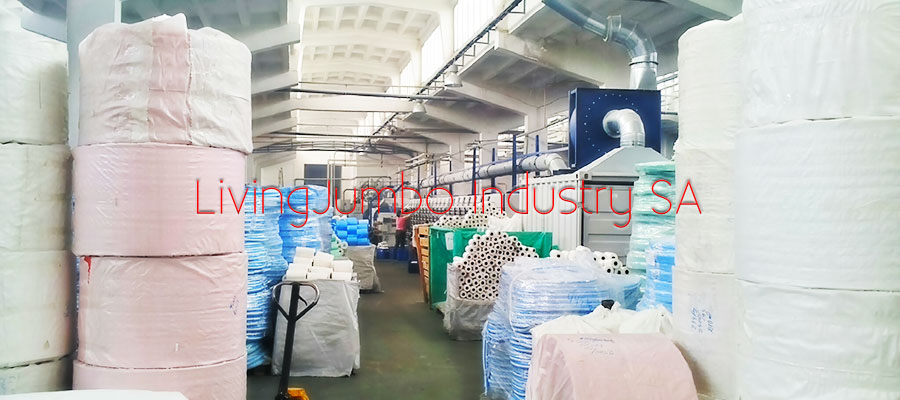
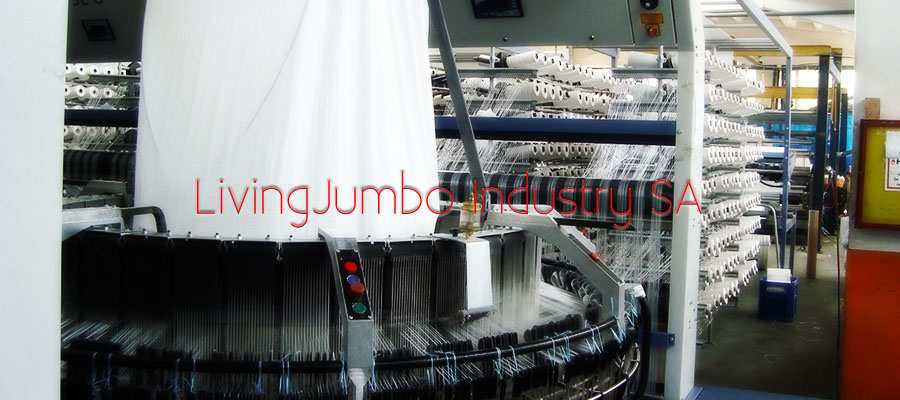
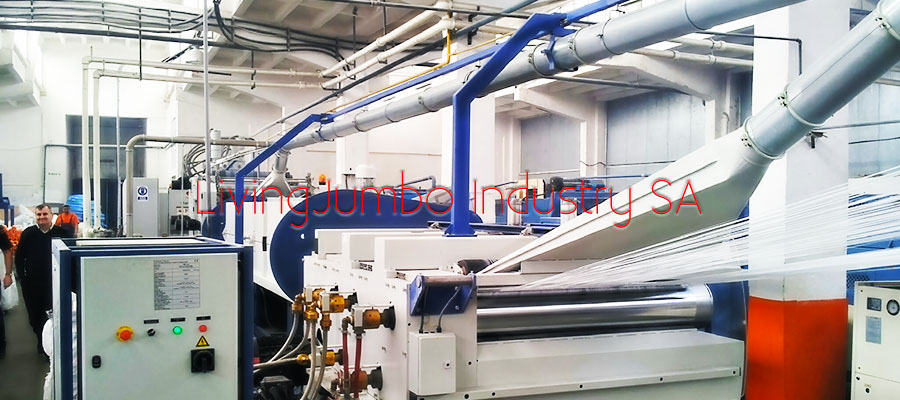
Unul dintre marile avantaje ale Livingjumbo Industry S.A. este faptul ca majoritatea materiilor prime si materiale sunt produse in interiorul companiei, incepand de la firul de polipropilena, tesatura, chinga, ata de cusut, siret sau sfoara, pana la confectionarea sacilor big bags.
Multumita acestui avantaj putem controla cu strictete calitatea si specificatiile solicitate de clientii nostri, indiferent ca este vorba de:
saci big bags cu 1 (un) maner de diferite tipuri (cu fund patrat, fund simplu indoit sau fund conic);
saci big bags cu 2 (doua) manere de diferite tipuri;
saci big bags cu 4 (patru) manere de diferite tipuri;
saci Q bags (cu pereti interiori) din tesatura laminata sau nelaminata;
coasere cu snur anti-praf sau cu insertie de huse din polietilena (PE).
In afara de saci big bags, Livingjumbo Industry S.A. produce si comercializeaza de asemenea:
tesaturi PP;
ate de cusut PP;
sfori PP;
chingi PP.
In scopul livrarii produselor noastre utilizam diverse canale de distributie:
direct la utilizatorii finali;
prin intermediul comisionarilor;
prin intermediul companiilor/distribuitorilor.
Indiferent de canalul de distributie folosit, Livingjumbo Industry S.A. asigura atat calitatea produselor sale, cat si livrarea rapida - abilitati care ne permit mentinerea si chiar cresterea cotei de piata si a portofoliului de clienti.
In acest mod sacii nostri big bags sunt prezenti pe piete de desfacere dintre cele mai exigente care solicita caracteristici constructive diverse, imprimari speciale, etc.
In cei 5 ani de prezenta pe piata (din anul 2002), compania noastra a vandut mai mult de 5 milioane de diferite tipuri de saci big bags.
Desi initial capacitatea de productie a fost proiectata pentru 30 000 de bucati pe luna, calitatea produselor noastre a fost si este in continuare foarte apreciata de catre partenerii nostri, reprezentand cel mai puternic emisar al promovarii imaginii Livingjumbo Industry S.A.
Urmand directive speciale de asigurare a succesului activitatii, am continuat "lupta" pentru competitivitate, utilizand unelte de publicitate agresiva, printre care:
calitate superioara;
preturi rezonabile;
flexibilitate in productie;
termene de livrare rapide.
Sistemul de management al calitatii ISO 9001/2001 ne-a sustinut permanent in asigurarea unei bune trasabilitati a produselor noastre, motiv pentru care echipa de conducere si Consiliul de Administratie au aprobat cresterea capacitatii de productie de la 30 000 pana la 120 000 bucati saci big bags pe luna.
Intelegand ca pentru a rezista atacurilor tot mai puternice ale concurentei de pe diferitele piete de desfacere singura solutie este cresterea productivitatii muncii si realizarea de economii la scara, in anul 2006 Livingjumbo Industry S.A. a achizitionat tehnologie care ne asigura producerea si livrarea unui numar de cel putin 160 000 big bags lunar.
POLITICA DE RESPONSABILITATE SOCIALA
POLITICA PRIVIND ACHIZITIILE DURABILE
POLITICA PRIVIND SCHIMBARILE CLIMATICE
DECLARATIA MANAGEMENTULUI PRIVIND POLITICA DE CALITATE
Suntem deplin convinsi ca cel mai important actionar al companiei noastre este CLIENTUL.
Depindem de client si fara el nu am exista.
Ca rezultat, esenta policii in domeniul calitatii in cadrul Livingjumbo Industry S.A. este ASIGURAREA ATENTIEI DEPLINE acordate CLIENTULUI cu scopul de a identifica si a satisface complet necesitatile acestuia.
Pentru a deveni mai eficienti si a ne dovedi abilitatea de a livra in mod constant produse inalt calitative - abilitatea de a transforma dorintele clientilor in exigente, LIVINGJUMBO INDUSTRY a proiectat si implementat un Sistem de Management al Calitatii modern, in conformitate cu prevederile standardului SR EN ISO 9001:2001.
Atat modalitatile de actiune, cat si modul de indeplinire a obiectivelor companiei noastre sunt mentionate in documentatia de implementare a Sistemului de Management al Calitatii, dupa cum urmeaza:
obtinerea unei rate ridicate de profitabilitate prin imbunatatirea calitatii muncii angajatilor nostri;
satisfacerea cerintelor clientilor, asa cum sunt ele exprimate si transmise;
mentinerea unui contact permanent cu clientul si verificarea opiniilor sale prin cercetare de marketing (chestionare);
promovarea imaginii companiei pe piata.
Intregul personal al LIVINGJUMBO INDUSTRY S.A. are obligatia sa cunoasca si sa respecte intocmai specificatiile mentionate in documentatia aferenta Sistemului de Management al Calitatii si sa depuna eforturi constante in vederea imbunatatirii activitatii proprii.
Reprezentantul Managementului Calitatii - in persoana Directorului de Calitate - are sarcina permanenta de a urmari:
modul in care procesele Sistemului de Management al Calitatii sunt stabilite, implementate, mentinute;
modul in care documentatia specifica este aplicata.
Imi asum intreaga responsabilitate de a analiza periodic eficienta si eficacitatea Sistemului de Management al Calitatii si de a identifica si asigura existenta resurselor necesare imbunatatirii continue a acestuia.
Director general
DECLARATIA MANAGEMENTULUI PRIVIND POLITICA DE MEDIU
S.C. LIVINGJUMBO INDUSTRY S.A. Buzau activeaza in aria productiei de saci tip big bags.
Considerand faptul ca activitatea Livingjumbo Industry S.A. implica un consum de resurse naturale, cum ar fi: apa, electricitate, gaze naturale si are un anumit impact asupra mediului (in principal prin poluarea cu polietilena si polipropilena) promisiunea noastra este de a asigura in mod continuu prevenirea poluarii mediului, promisiune dusa la indeplinire prin intermediul obiectivelor si tintelor stabilite, dupa cum urmeaza:
reducerea consumului de energie electrica;
reducerea consumului de uleiuri specifice;
reducerea consumului de apa;
reducerea cantitatii de deseuri rezultate din procesul de productie.
In cadrul efortului permanent de imbunatatire a activitatii generale, conducerea Livingjumbo Industry S.A. se angajeaza sa respecte cerintele legale si celelalte cerinte aplicabile referitoare la mediul inconjurator, se angajeaza sa mentina o buna comunicare cu partile implicate si de asemenea sa militeze pentru protejarea resurselor naturale.
Intregul personal al Livingjumbo Industry S.A. are obligatia de a cunoaste - prin actiuni de instruire - cerintele Managementului de Mediu si de a depune eforturi constante in vederea imbunatatirii activitatii generale zilnice.
Ne asumam intreaga responsabilitate de a analiza periodic eficienta si eficacitatea sistemelor integrate de Management al Calitatii si al Mediului, de a identifica si de a asigura disponibilitatea resurselor necesare unei permanente imbunatatiri generale a activitatii.
Prezenta politicii de mediu este comunicata, listata in locuri vizibile si adusa la cunostinta intregului personal al companiei.
Director General
Situata in Estul Europei, la limita recent extinsei Uniuni Europene, Livingjumbo Industry S.A. reprezinta un producator si distribuitor de saci big bags "near shore", facilitand posibilitatea partenerilor europeni de a ne vizita, asigurand astfel increderea si controlul asupra calitatii pe care acestia o "cumpara" de la noi.
De la 01 Ianuarie 2007 Romania a devenit membra a Uniunii Europene, ocazie care ne aduce o serie de avantaje competitive ca si companie romana, cum ar fi:
Avantajul locatiei
romania se "comporta" ca un pod, unind Estul cu Vestul si Nordul cu Sudul Europei.
Avantajul diferentei de fus orar
diferenta apropiata de fus orar (GMT + 2) asigura faptul ca o directa comunicare poate avea loc cu personalul Livingjumbo Industry S.A. la ore normale pe teritoriul Europei.
Avantajul riscului de tara minim
ca membru al Uniunii Europene, Romania respecta legi similare cu ale restului tarilor europene, asigurand in acest fel desfasurarea cu usurinta si incredere a unor relatii de afaceri. Apartenenta la Uniunea Europeana, stabilitatea si cresterea economica fac din Romania o tara cu risc minim, propice dezvoltarii unor afaceri profitabile.
Avantajul cultural
situata in "inima" Europei, Romania impartaseste aceleasi valori culturale, usurand colaborarea cu firmele partenere si eliminand posibilitatea aparitiei unor neintelegeri din acest punct de vedere.
Personalul foarte bun vorbitor de limbi straine permite companiilor din intreaga lume sa lucreze cu Livingjumbo Industry intr-o maniera usoara si apropiata, beneficiind de o comunicare directa.
Numarul mare de genii - din punct de vedere intelectual - precum si posibilitatea de demarare rapida a afacerilor atrag companiile straine: cercetatorii romani sunt foarte experimentati, cu o puternica baza teoretica, multi dintre acestia avand deja un trecut in laboratoarele si grupurile de lucru europene si fiind deci la curent cu ultimele "tendinte".
Infrastuctura IT este foarte bine dezvoltata, la fel si parti ale infrastructurii experimentale.
Companiile romane beneficiaza de personal cu excelente abilitati de negociere: majoritatea contactelor cu partenerii de afaceri se desfasoara prin comertul direct, targuri, expozitii, vizite pe pagini web si in unele cazuri prin intermediul Camerelor de Comert.
Suntem deplin convinsi ca cel mai important actionar al companiei noastre este CLIENTUL. De aceea, noi oferim:
cea mai buna calitate a materiilor prime, materialelor si a produselor finite;
livrari in sistem JIT ("just-in-time") in scopul mentinerii la un nivel minim sau zero al stocurilor cu respectarea sistemului trasabilitatii produselor;
asistenta in vederea gasirii celor mai bune solutii si a mentinerii unui parteneriat de succes;
flexibilitate de executie in functie de necesitati;
nivelul inalt de calificare al angajatilor si posibilitatea comunicarii in timp real in diferite limbi de circulatie: Engleza, Franceza, Germana, Italiana, Spaniola.
Permanenta preocupare de dezvoltare prin implementarea sistemelor de management al mediului ISO 14001 si siguranta produselor alimentare HACCP-ISO22000, achizitii de tehnologii performante si perfectionarea continua a personalului.
Toate aceste motive au dus la crearea unui portofoliu impresionant de peste 500 de clienti ce activeaza in industrii diverse: industria materialelor de constructii, industria alimentelor granulare, industria chimica, fertilizatori, agricultura, industria constructiilor, a reciclarii, ca sa numim doar o parte din domeniile catre care se adreseaza sacii de tip big bags.
POLITICA DE CONFIDENTIALITATE
1. Ce sunt datele cu caracter personal?
Datele cu caracter personal - orice informatie referitoare la o persoana fizica identificata sau identificabila, cum ar fi numele, adresa, detaliile bancii, date de localizare, identificatori online etc.
2. Ce tipuri de date personale colectam?
Datele personale colectate despre dumneavoastra se pot referi la nume, adresa, e-mail, numar de telefon.
3. In ce scop colectam datele personale?
In principal, scopul colectarii si prelucrarii datelor cu caracter personal furnizate de dumneavoastra este acela de a ne ajuta sa ne Imbunatatim serviciile si de a va furniza informatii sau produsele solicitate. Totodata, atunci cand dumneavoastra va dati acordul expres, va vom informa si cu privire la produse sau servicii suplimentare care ar putea fi de interes pentru dumneavoastra, in scop de marketing.
SC LIVINGJUMBO INDUSTRY S.A nu va vinde, comercializa sau Inchiria informatiile dumneavoastra personale. Datele dumneavoastra nu vor fi transmise unei terte parti, cu exceptia situatiei In care SC LIVINGJUMBO INDUSTRY S.A este obligat din punct de vedere legal sa faca acest lucru.
4. Care sunt drepturile dumneavoastra in legatura cu prelucrarea datelor?
In conformitate cu legislatia aplicabila in domeniul protectiei datelor cu caracter personal, aveti urmatoarele drepturi:
• dreptul de acces la datele prelucrate;
• dreptul de a rectifica datele inexacte sau completarea acestor date;
• dreptul de portabilitate;
• dreptul de solicita stergerea datelor cu caracter personal;
• dreptul de a solicita restrictionarea prelucrarii datelor;
• dreptul de a va opune prelucrarii datelor;
• dreptul de a va retrage oricand consimtamantul dat;
• dreptul de a depune o plangere la o autoritate de supraveghere atunci cand considerati ca s-au incalcat dispozitiile legale in materia protectiei datelor cu caracter personal.
In vederea exercitarii drepturilor dumneavoastra ne puteti transmite solicitarile dumneavoastra prin e-mail, la urmatoarea adresa: dataprotection@livingjumbo.ro.
Inainte de a va furniza/corecta/sterge etc. datele, va vom solicita o dovada a identitatii si informatii suficiente despre interactiunea dumneavoastra cu noi, astfel incat sa putem gasi toate datele relevante in legatura cu
dumneavoastra. De asemenea, va putem percepe o taxa pentru furnizarea unei copii a datelor dumneavoastra, in cazul in care solicitarea dumneavoastra presupune un efort excesiv sau implica costuri semnificative pentru SC LiViNGJUMBO iNDUSTRY S.A.
5. Retinerea si stergerea datelor
Datele dumneavoastra cu caracter personal sunt colectate si prelucrate pe intreaga perioada cat vizitati site-ul nostru sau aveti o relatie contractuala cu SC LIVINGJUMBO INDUSTRY S.A
Astfel, nu vom pastra informatiile dumneavoastra personale mai mult decat este necesar pentru scopul pentru care sunt colectate.
6. Cum securizam datele dumneavoastra
SC LIVINGJUMBO INDUSTRY S.A ia in serios siguranta datelor, astfel ca folosim tehnologii si proceduri adecvate pentru protejarea informatiilor personale.
Politicile si procedurile noastre sunt revizuite periodic si actualizate in conformitate cu cele mai noi standarde internationale in materia protectiei datelor cu caracter personal. Cu titlu de exemplu:
• detinem politici si proceduri privind protectia datelor cu caracter personal;
• avem masuri ce protejeaza impotriva pierderii accidentale si a accesului/utilizarii/distrugerii/dezvaluirii a datelor cu caracter personal;
• efectuam evaluari de impact asupra confidentialitatii in conformitate cu GDPR;
• efectuam audituri si punem in aplicare masuri pentru siguranta protectiei datelor;
• instruim angajatii cu privire la protectia datelor cu caracter personal;
• toti angajatii si colaboratorii nostri au incheiate cu noi contracte de confidentialitate.
PROTECTIA DATELOR
1. SCOPUL POLITICII DE PROTECTIA DATELOR
Prezenta politica de protectie a datelor cu caracter personal se aplica tuturor categoriilor de date personale prelucrate de entitatile din cadrul SC LIVINGJUMBO INDUSTRY S.A (denumit in continuare „Living Jumbo”).
Exista numeroase motive pentru care datele cu caracter personal sunt colectate si pastrate de LIVING JUMBO.
Prin aceasta politica LIVING JUMBO isi propune ca angajatii, viitorii si actualii parteneri de afaceri, viitorii si actualii clienti sa aiba certitudinea ca prelucrarea datelor lor personale se bazeaza pe
principii acceptate la nivel european in domeniul protectiei datelor.
La intocmirea acestei politici a fost avut in vedere Regulamentul (UE) 679/2016 al Parlamentului European si al Consiliului, privind protectia persoanelor fizice in ceea ce priveste prelucrarea datelor cu
caracter personal si privind libera circulatie a acestor date si de abrogare a Directivei 95/46/CE (in continuare „GDPR”).
Nerespectarea cerintelor acestei politici atunci când se prelucreaza date cu caracter personal conduce la incalcarea dispozitiilor legale. incalcarea dispozitiilor din prezenta politica poate aduce atingere drepturilor si intereselor persoanelor vizate.
Politica de protectie a datelor cu caracter personal este responsabilitatea intregului personal LIVING JUMBO si a oricarei persoane care acceseaza si utilizeaza informatiile cu caracter personal.
2. DOMENIUL DE APLICARE, PERSOANELE VIZATE sI MODIFICAREA POLITICII
Politica de protectie a datelor cu caracter personal se aplica tuturor informatiilor personale prelucrate de catre sau in numele LIVING JUMBO. Aceste date cu caracter personal prelucrate de LIVING JUMBO includ, dar nu se
limiteaza la contractori, consultanti, angajati, clienti, potentiali angajati si clienti. Politica se aplica indiferent de locatia de unde sunt accesate datele cu caracter personal.
Formatele in care se manipuleaza datele cu caracter personal pot varia de la cele electronice, tiparite, la cele multimedia.
Prezenta politica nu se aplica informatiilor anonime, adica informatiilor care nu sunt legate de o anumita persoana identificata sau identificabila sau datelor cu caracter personal care sunt anonimizate astfel incat persoana
vizata nu este sau nu mai este identificabila.
Datele personale/datele cu caracter personal reprezinta orice informatie referitoare la o persoana fizica identificata sau identificabila, cum ar fi numele, adresa, detaliile bancii, date de localizare, identificatori online etc.
Aceasta politica este revizuita ori de câte ori este necesar in vederea transpunerii legislatiei in domeniu.
3. APLICAREA LEGISLATIEI NATIONALE
Aceasta politica are in vedere transpunerea principiilor GDPR si se completeaza cu dreptul intern care va putea impune obligatii mai exigente in privinta prelucrarii datelor cu caracter personal, ceea ce impune revizuirea politicii periodic.
4. PRINCIPIILE DE PRELUCRARE A DATELOR CU CARACTER PERSONAL
4.1. Legalitate, echitate si transparenta
Conform acestui principiu, persoana vizata trebuie sa fi fost informata cu privire la prelucrare, prelucrarea trebuie sa fie conform indicatiilor oferite persoanei vizate si sa aiba un scop legal.
Prelucrarea datelor este considerata legala atunci când se aplica cel putin una dintre conditiile prevazute la art. 6 din GDPR.
Persoana vizata trebuie informata in mod clar si deschis cum se vor prelucra datele sale.
In general, datele cu caracter personal trebuie colectate direct de la persoana in cauza.
Ca urmare a prelucrarii datelor cu caracter personal, indiferent ca datele au fost obtinute direct sau nu de la persoana vizata, LIVING JUMBO va furniza acesteia urmatoarele informatii:
- identitatea si datele de contact ale societatii;
- datele de contact ale persoanei responsabile cu protectia datelor;
- scopul in care sunt prelucrate datele cu caracter personal;
- temeiul juridic al prelucrarii;
- interesele legitime urmarite de societate sau de un tert atunci când prelucrarea este necesara in scop legitim;
- destinatarii sau categoriile de destinatari ai datelor cu caracter personal;
- perioada pentru care vor fi stocate datele cu caracter personal (daca acest lucru este posibil).
4.2. Limitarea scopului
Datele personale pot fi prelucrate numai in scopul definit inainte de colectarea datelor si comunicat persoanei vizate, fara a putea fi folosite ulterior intr-un mod incompatibil cu scopul comunicat.
Astfel, modificari ulterioare ale scopului sunt posibile doar intr-o masura limitata si necesita o fundamentare solida.
4.3. Minimizarea datelor
Datele cu caracter personal trebuie sa fie adecvate, relevante si limitate la ceea ce este necesar in raport cu scopul in care sunt prelucrate.
4.4. Exactitatea si actualitatea datelor
Datele personale colectate trebuie sa fie exacte, complete si, daca este necesar, sa fie actualizate. LIVING JUMBO va lua masuri rezonabile pentru a se asigura ca datele colectate sunt exacte, iar sursa acestora este cunoscuta.
In situatia in care datele cu caracter personal sunt inexacte, avand in vedere scopurile pentru care sunt prelucrate, sunt sterse sau rectificate fara intarziere.
4.5. Limitarea legata de stocare datelor
Datele cu caracter personal trebuie pastrate intr-o forma care permite identificarea persoanelor vizate pe o perioada care nu depaseste perioada necesara indeplinirii scopurilor in care sunt prelucrate datele.
Astfel, datele personale nu trebuie pastrate daca nu mai sunt necesare scopului pentru care au fost colectate, cu exceptia situatiei in care dreptul Uniunii sau dreptul intern impun stocarea datelor cu caracter personal.
4.6. Reducerea si economia datelor
Inainte de a procesa date personale, trebuie determinat daca si in ce masura prelucrarea acestora este necesara pentru atingerea scopului pentru care este efectuata.
Acolo unde scopul permite si unde cheltuielile implicate sunt proportionale cu obiectivul, trebuie folosite date anonime.
Datele personale nu pot fi colectate in avans si stocate in scopuri potentiale viitoare, cu exceptia cazului in care acest lucru este impus sau permis de legislatia in domeniu.
4.7. Integritate si confidentialitate
Datele cu caracter personal sunt considerate informatii confidentiale, fiind pastrate in siguranta de catre persoanele responsabile cu protectia datelor,
care iau masuri tehnice si organizatorice necesare pentru a preveni accesul neautorizat la date, prelucrarea ilegala, pierderea sau distrugerea/deteriorarea accidentala a datelor.
5. PRELUCRAREA DATELOR CU CARACTER PERSONAL
LIVING JUMBO si orice persoana care actioneaza in numele LIVING JUMBO , inclusiv afiliati etc., vor prelucra datele persoanelor vizate in baza unor temeiuri juridice.
5.1. Date despre parteneri si clienti
5.1.1. Prelucrarea datelor pentru o relatie contractuala
Datele personale ale partenerilor si ale clientilor pot fi prelucrate in scopul incheierii, executarii sau rezilierii contractelor.
Totodata, datele personale pot fi prelucrate si anterior incheierii unui contract pentru transmiterea unei oferte, primirea unei comenzi etc.
In situatia in care prelucrarea datelor cu caracter personal se face in baza consimtamantului, LIVING JUMBO se va asigura ca a obtinut acordul intr-un format
clar si explicit care va cuprinde toate drepturile persoanei vizate (acces, rectificare, retragere consimtamant etc.).
5.1.2. Prelucrarea datelor in scopuri publicitare
Atunci cand se doreste prelucrarea datelor in scopuri publicitare, persoana vizata va fi informata intr-un mod clar cu privire la utilizarea datelor sale in aceste scopuri,
cu exceptia marketingului direct, cand LIVING JUMBO va putea prelucra datele cu caracter personal, in conformitate cu considerentul 47 din GDPR.
In situatia in care clientul solicita sa fie informat cu privire la campaniile publicitare, LIVING JUMBO va lua un consimtamant in acest sens,
iar clientul va avea posibilitatea de a alege modalitatea in care i se vor transmite materialele publicitare (ex. e-mail, sms, posta etc.).
In situatia in care persoana vizata solicita ca datele sale cu caracter personal sa nu mai fie folosite in scopuri publicitare, LIVING JUMBO se
va asigura ca datele nu vor mai fi prelucrate in acest scop, urmand a fi sterse.
5.1.3. Consimtamantul la prelucrarea datelor
Consimtamantul trebuie sa fie clar, in scris, inclusiv prin mijloace electronice sau printr-o declaratie orala (ex. cu ocazia unei conversatii telefonice).
Astfel, consimtamantul trebuie luat pentru o anumita activitate de prelucrare a datelor personale si pentru unul sau mai multe scopuri specifice.
In situatia luarii acordului in format electronic, pre-bifarea unor casute referitoare la consimtamant vor conduce la nevalabilitatea acestuia.
LIVING JUMBO se va asigura ca poate face dovada ca persoana vizata si-a dat consimtamantul in scopul prelucrarii datelor sale.
Persoana vizata are dreptul sa-si retraga consimtamantul in orice moment. Retragerea consimtamantului nu afecteaza legalitatea prelucrarii inainte de retragerea acestuia.
5.1.4. Prelucrarea datelor in conformitate cu legea
Prelucrarea datelor cu caracter personal poate avea loc in baza unui temei din dreptul Uniunii/dreptul intern.
5.1.5. Prelucrarea datelor in temeiul unui interes legitim
Datele cu caracter personal pot fi prelucrate in baza unui interes legitim. inainte de a prelucra date cu caracter personal folosind ca baza legala interesul legitim,
LIVING JUMBO va face testele necesare de echilibru pentru a se asigura ca procesarea este corecta si respecta drepturile persoanelor vizate.
5.1.6. Prelucrarea datelor sensibile
Prelucrarea de categorii speciale de date cu caracter personal este interzisa cu exceptia situatiilor
in care persoana vizata si-a dat consimtamantul explicit pentru prelucrarea acestor categorii de date ori prelucrarea este necesara in scopuri de medicina preventiva a muncii sau de indeplinire a unei obligatii legale.
5.1.7. Decizii individuale automatizate
LIVING JUMBO nu recurge la luarea unor decizii bazate exclusiv pe prelucrarea automata a datelor.
Totusi, in situatia in care decizia a fost luata in mod automat, LIVING JUMBO va implementa masuri in vederea respectarii drepturilor persoanelor vizate
(interventia unei persoane pentru a interpreta decizia, dreptul persoanei vizate de a-si exprima un punct de vedere, dreptul persoanei vizate de a contesta decizia).
5.1.8. Date utilizator si internet
LIVING JUMBO colecteaza date cu caracter personal si prin intermediul site-ului detinut, astfel ca in cadrul site-ului sunt implementate Politici de confidentialitate si Politici de cookie-uri.
6. TRANSMITEREA DATELOR CU CARACTER PERSONAL
Datele cu caracter personal pot fi transmise catre persoane din afara sau din interiorul LIVING JUMBO numai cu avizul prealabil al Responsabilului cu protectia datelor.
Datele astfel transmise pot fi utilizate doar in scopul pentru care persoanele vizate si-au dat consimtamantul.
Transferul datelor catre tari terte sau organizatii internationale se poate realiza atunci cand destinatarul datelor asigura un nivel de protectie adecvat sau atunci cand exista
garantii adecvate, drepturi opozabile si cai de atac eficiente pentru persoanele vizate. Nu intra in aceasta categorie transferul datelor catre statele membre.
LIVING JUMBO va intocmi o lista cu tertii carora le-a transmis datele.
7. PRELUCRAREA DATELOR PRIN INTERMEDIUL PERSOANELOR IMPUTERNICITE
Prelucrarea datelor cu caracter personal poate avea loc si prin intermediul persoanelor imputernicite, atunci cand
acestea ofera garantii suficiente in vederea respectarii acestei politici, a dreptului Uniunii sau a dreptului intern.
LIVING JUMBO se va asigura ca mai inainte de colectarea si prelucrarea datelor de catre un imputernicit in numele sau a incheiat cu acesta un contract ce va cuprinde clauze
ce impun minim aceleasi masuri de securitate si conformitate cu privire la protectia datelor cu caracter personal ca cele aplicate de LIVING JUMBO.
8. ASPECTE GENERALE REFERITOARE LA RAPORTUL LIVING JUMBO – PERSOANE VIZATE
LIVING JUMBO va respecta dreptul de acces al persoanelor vizate si va raspunde solicitarilor/intrebarilor/reclamatiilor acestora.
Atunci cand persoana viata solicita rectificarea, stergerea etc. a datelor cu caracter personal, se va informa de indata directorul general asupra acestui aspect.
LIVING JUMBO va raspunde solicitarilor/intrebarilor/reclamatiilor persoanelor vizate in termen de cel mult 30 de zile de la primirea acestora.
Atunci cand este cazul, se vor evalua si negocia costurile ce ar putea fi suportate de LIVING JUMBO pentru a se conforma instructiunilor care necesita utilizarea unor
resurse diferite sau in plus fata de cele necesare pentru furnizarea serviciilor ce fac obiectul contractelor incheiate intre LIVING JUMBO si parteneri, clienti etc.
8.1. Drepturile individuale ale persoanelor vizate
Datele cu caracter personal trebuie procesate in acord cu drepturile individuale ale persoanelor vizate, precum:
• dreptul de a solicita accesul la date, rectificarea sau restrictionarea prelucrarii datelor cu caracter personal;
• dreptul la portabilitatea datelor;
• dreptul de a fi uitat;
• dreptul de a se opune prelucrarii datelor;
• dreptul de a retrage consimtamantul;
• dreptul de a se opune luarii unei decizii in mod automat;
• dreptul de a depune o plangere in fata unei autoritati.
In vederea respectarii drepturilor persoanelor vizate, LIVING JUMBO poate fi contactat prin e-mail, la dataprotection@livingjumbo.ro ,
sau prin posta, la urmatoarea adresa Str. Transilvaniei, Nr. 132, Buzau.
8.2. Notificarea persoanelor vizate
In situatia obtinerii datelor cu caracter personal de la persona vizata, LIVING JUMBO, in momentul obtinerii acestor date, furnizeaza persoanei vizate urmatoarele informatii:
• identitatea si datele de contact ale societatii şi, dupa caz, ale reprezentantului acesteia;
• datele de contact ale responsabilului cu protectia datelor, dupa caz;
• scopurile in care sunt prelucrate datele cu caracter personal, precum si temeiul juridic al prelucrarii;
• interesele legitime urmarite de societate sau de o parte terta;
• destinatarii datelor cu caracter personal;
• intentia societatii de a transfera datele catre o tara terta sau o organizatie internationala;
• perioada pentru care vor fi stocate datele sau daca acest lucru nu este posibil, criteriile utilizate pentru a stabili aceasta perioada;
• drepturile persoanelor vizate (acces, rectificare, stergere etc.);
• dreptul de a-si retrage consimtamantul atunci cand prelucrarea se bazeaza pe acesta;
• daca furnizarea datelor reprezinta o obligatie legala sau este necesara in vederea incheierii/executarii unui contract si eventualele consecinte ale nerespectarii acestei obligatii;
• existenta unui proces decizional automatizat.
9. CONFIDENTIALITATEA PROCESARII
Datele cu caracter personal sunt considerate confidentiale, astfel ca orice prelucrare sau utilizare a acestora este supusa autorizarii prealabile. Persoanele care prelucreaza
date cu caracter personal sunt informate despre caracterul confidential al datelor si au incheiate acorduri scrise de confidentialitate, fiind totodata instruite cu privire la responsabilitatile lor.
LIVING JUMBO va depune toate diligentele pentru ca angajatii care lucreaza cu date personale sa aiba acces limitat asupra acestora, pe nivele si in functie de scopul prelucrarii.
Angajatii nu au voie sa dezvaluie datele cu caracter personal unei alte persoane neautorizate, inclusiv din cadrul LIVING JUMBO.
10. SECURITATEA PRELUCRARII
LIVING JUMBO trebuie sa implementeze si sa mentina masuri tehnice si organizatorice destinate protejarii datelor cu caracter personal,
inclusiv protejarii confidentialitatii si integritatii datelor clientilor.
Datele cu caracter personal vor fi stocate in siguranta si vor fi accesibile numai personalului autorizat. Informatiile vor fi stocate atat timp cat sunt necesare sau cerute de
dreptul Uniunii/dreptul intern, urmand ca la finalul perioadei a se dispune in mod corespunzator in conformitate cu Retinerea, arhivarea si distrugerea datelor.
Persoanele vizate si autoritatile vor fi notificate in conformitate cu GDPR despre eventualele incidente in legatura cu securitatea datelor (ex. distrugere, pierdere,
modificare/dezvaluire/acces neautorizat la datele cu caracter personal) fara intarzieri nejustificate.
11. CONTROLUL PROTECTIEI DATELOR
LIVING JUMBO se obliga sa efectueze evaluari/audituri periodice in legatura cu protectia datelor si sa identifice cea mai eficienta modalitatea de a-si respecta obligatiile ce decurg din prelucrarea datelor cu caracter personal. La cererea autoritatilor de supraveghere, LIVING JUMBO va pune la dispozitia acestora rezultatele obtinute in urma evaluarilor/auditurilor.
12. INCIDENTELE DE PROTECTIE A DATELOR
LIVING JUMBO va implementa si detine politici si proceduri de gestionare a incidentelor de securitate, notificand persoanele vizate despre un
eventual incident in legatura cu securitatea datelor, fara intarzieri nejustificate.
LIVING JUMBO va monitoriza, prin intermediul persoanei responsabile cu protectia datelor, riscurile noi si in curs referitoare la protectia
datelor cu caracter personal, actualizand de indata registrul relevant al riscurilor la nivelul LIVING JUMBO .
In cazul in care are loc o incalcare a securitatii datelor cu caracter personal, LIVING JUMBO va notifica acest lucru si autoritatii de supraveghere, fara intarzieri nejustificate si daca este posibil in cel mult 72 de ore de la data la care a luat la cunostinta de aceasta,
cu exceptia cazului in care este susceptibila sa genereze un risc pentru drepturile si libertatile persoanelor fizice.
13. RESPONSABILITATI SI SANCTIUNI
Este responsabilitatea intregului personal al LIVING JUMBO sa notifice imediat Responsabilului cu protectia datelor orice incalcare a
prezentei politici. Atunci cand Responsabilul cu protectia datelor va considera necesar, va informa autoritatea de supraveghere despre
aceste incalcari.
Sefii fiecarui departament din cadrul LIVING JUMBO vor fi responsabili pentru prelucrarea datelor din cadrul departamentelor lor si vor
monitoriza riscurile noi si in curs referitoare la protectia datelor/vor actualiza registrul relevant al riscurilor la nivelul companiei.
In cazul sesizarii unui risc, vor raporta acest lucru de indata directorului general si Responsabilului cu protectia datelor.
Sefii fiecarui departament in cadrul caruia se prelucreaza date cu caracter personal vor informa Responsabilul cu protectia datelor
in timp util cu privire la o fiecare noua prelucrare a datelor.
Directorul general, impreuna cu Responsabilul cu protectia datelor se vor ingriji ca periodic sa se efectueze un audit intern al LIVING JUMBO
prin care sa se verifice gestionarea riscurilor privind confidentialitatea si protectia datelor.
Directorul general este responsabil pentru asigurarea masurilor tehnice si organizatorice pentru ca orice prelucrare a datelor sa se
efectueze in conformitate cu prezenta politica, GDPR, dreptul Uniunii/dreptul intern. Directorul general poate desemna in
acest sens alte persoane.
Toti angajatii LIVING JUMBO care lucreaza cu date personale au obligatia de a informa imediat Responsabilul cu protectia datelor
cu privire la orice incalcare a prezentei politici sau a altor reglementari legale aplicabile in materie despre care au luat cunostinta.
Prelucrarea abuziva a datelor cu caracter personal va conduce la aplicarea de sanctiuni disciplinare, putand fi pedepsita
si de legislatia penala in domeniu.
14. STOCAREA/ARHIVAREA SI DISTRUGEREA DATELOR CU CARACTER PERSONAL
LIVING JUMBO se va asigura ca datele cu caracter personal sunt stocate atat timp cat informatiile sunt necesare scopului prelucrarii.
De la regula stocarii pe perioada cat informatiile sunt necesare scopului prelucrarii, LIVING JUMBO va avea in vedere si situatiile prevazute
de dreptul Uniunii/dreptul intern care reglementeaza situatii in care datele cu caracter personal se arhiveaza pentru o perioada
mai lunga de timp. Cu titlu de exemplu, datele cu caracter personal aflate pe unele documente (contabile, financiare etc.)
vor fi stocate atat cat prevede legislatia in vigoare – a se vedea Politica de stocare a documentelor si inregistrarilor.
La finalul perioadei prelucrarii datelor cu caracter personal, acestea vor fi sterse in conditii de siguranta, dupa obtinerea
unei autorizatii in acest sens din partea directorului general. Exceptie face situatia in care dreptul Uniunii/dreptul intern
interzic stergerea acestor date.
15. DEFINITII
| TERMEN | DEFINITIE |
| GDPR | Regulamentul (UE) nr. 679/2016 al Parlamentului European si al Consiliului privind protectia persoanelor fizice in ceea ce priveste prelucrarea datelor cu caracter personal si libera circulatie a acestor date. |
| DATE CU CARACTER PERSONAL | Orice informatie referitoare la o persoana fizica identificata sau identificabila, cum ar fi numele, adresa, detaliile bancii, date de localizare, identificatori online etc. |
| DATE SENSIBILE | Date despre originea rasiala si etnica, despre opiniile politice, religioase sau credintele filosofice, calitatea de membru al unor organizatii, date privind cazierul judiciar sau sanatatea si orientarea sexuala a persoanei vizate. |
| DATE PRIVIND SANATATEA | Date cu caracter personal legate de sanatatea fizica sau mentala a unei persoane fizice, inclusiv prestarea de servicii de asistenta medicala, care dezvaluie informatii despre starea de sanatate a acesteia. |
| PRELUCRAREA DATELOR | Orice operatiune sau set de operatiuni efectuate asupra datelor cu caracter personal sau asupra seturilor de date cu caracter personal, cu sau fara utilizarea de mijloace automatizate, cum ar fi colectarea, inregistrarea, organizarea, structurarea, stocarea, adaptarea sau modificarea, extragerea, consultarea, utilizarea, divulgarea prin transmitere, diseminarea sau punerea la dispozitie in orice alt mod, alinierea sau combinarea, restrictionarea, stergerea sau distrugerea. |
| RESTRICTIONAREA PRELUCRARII | Marcarea datelor cu caracter personal stocate cu scopul de a limita prelucrarea viitoare a acestora. |
| SISTEM DE EVIDENTA A DATELOR | Orice set structurat de date cu caracter personal accesibile conform unor criterii specifice, fie ele centralizate, descentralizate sau repartizate dupa criterii functionale sau geografice. |
| CONSIMTAMANTUL | Orice manifestare de vointa libera, specifica, informata si lipsita de ambiguitate a persoanei vizate prin care aceasta accepta, printr-o declaratie sau printr-o actiune fara echivoc, ca datele cu caracter personal care o privesc sa fie prelucrate. |
| PERSOANA VIZATA | Persoana fizica ale carei date personale sunt prelucrate. |
| PERSOANA IMPUTERNICITA | Persoana fizica sau juridica, autoritatea publica, agentia sau alt organism care prelucreaza datele cu caracter personal in numele LIVING JUMBO. |
| PSEUDONIMIZAREA | Mascarea datelor prin inlocuirea informatiilor de identificare cu identificatorii artificiali. Desi poate contribui la protejarea confidentialitatii si securitatii datelor personale, pseudonimizarea are limitele sale, motiv pentru care GDPR mentioneaza de asemenea criptarea. |
| CRIPTAREA | Ascunderea de informatii prin inlocuirea identificatorilor cu altceva. Fata de pseudonimizarea, care permite oricarei persoane care are acces la date sa vizualizeze o parte din setul de date, criptarea permite numai utilizatorilor aprobati sa acceseze intregul set de date. |
| TERT | Persoana fizica sau juridica, autoritate publica, agentie sau organism altul decat persoana vizata, operatorul, persoana imputernicita de operator si persoanele care, sub directa autoritate a operatorului sau a persoanei imputernicite de operator, sunt autorizate sa prelucreze date cu caracter personal. |
| STAT MEMBRU | Stat membru al Uniunii Europene (Austria, Belgia, Bulgaria, Croatia, Cipru, Republica Ceha, Danemarca, Estonia, Finlanda, Franta, Germania, Grecia, Malta, tarile de Jos, Polonia, Portugalia, Romania, Slovacia, Slovenia, Spania, Suedia si Regatul Unit). in urma prezentarii de catre Regatul Unit a unei notificari de retragere in temeiul articolului 50 din Tratatul de la Lisabona, Regatul Unit va ramane un stat membru al UE pana la miezul noptii (ora Bruxelles-ului) din 29 martie 2019, cu exceptia cazului in care Consiliul European decide in unanimitate prelungirea mandatului de negocieri cu inca doi ani. Regatul Unit va deveni o tara terta de la data retragerii. |
| TARILE TERTE | Toate natiunile din afara Uniunii Europene. |
| INCALCAREA SECURITATII DATELOR CU CARACTER PERSONAL | O incalcare a securitatii care duce, in mod accidental sau ilegal, la distrugerea, pierderea, modificarea, sau divulgarea neautorizata a datelor cu caracter personal transmise, stocate sau prelucrate intr-un alt mod, sau la accesul neautorizat la acestea. |
| AUTORITATE DE SUPRAVEGHERE | O autoritate publica independenta instituita de un stat membru in temeiul articolului 51 din GDPR. |
| MASURI TEHNICE SI ORGANIZATORICE DE SECURITATE | Securizarea datelor cu caracter personal intr-un mod care sa tina seama de pericolele potentiale la adresa intereselor si drepturilor persoanei vizate si care sa previna, printre altele, efectele discriminatorii impotriva persoanelor pe motiv de rasa sau origine etnica, opinii politice, religie sau convingeri, apartenenta sindicala, caracteristici genetice, stare de sanatate sau orientare sexuala sau care sa duca la masuri care sa aiba astfel de efecte. |
Date contact responsabil cu protectia datelor personale
Va comunicam ca, in temeiul art. 37 alin. 7 din REGULAMENTUL (UE) 2016/679 AL PARLAMENTULUI EUROPEAN SI AL CONSILIULUI din 27
aprilie 2016 privind protectia persoanelor fizice in ceea ce priveste prelucrarea datelor cu caracter personal si privind libera
circulatie a acestor date si de abrogare a Directivei 95/46/CE (Regulamentul general privind protectia datelor), pentru a va
adresa LIVING JUMBO in legatura cu protectia datelor va rugam folositi urmatoarele detalii de contact:
• Adresa postala: Buzau, str. Transilvaniei, Nr.132
• Adresa email: dataprotection@ivingjumbo.ro.
INTEGRITATE
1. Ce sunt datele cu caracter personal?
Datele cu caracter personal - orice informatie referitoare la o persoana fizica identificata sau identificabila, cum ar fi numele, adresa, detaliile bancii, date de localizare, identificatori online etc.
2. Ce tipuri de date personale colectam?
Datele personale colectate despre dumneavoastra se pot referi la nume, adresa, e-mail, numar de telefon.
3. In ce scop colectam datele personale?
In principal, scopul colectarii si prelucrarii datelor cu caracter personal furnizate de dumneavoastra este acela de a ne ajuta sa ne Imbunatatim serviciile si de a va furniza informatii sau produsele solicitate. Totodata, atunci cand dumneavoastra va dati acordul expres, va vom informa si cu privire la produse sau servicii suplimentare care ar putea fi de interes pentru dumneavoastra, in scop de marketing.
SC LIVINGJUMBO INDUSTRY S.A nu va vinde, comercializa sau Inchiria informatiile dumneavoastra personale. Datele dumneavoastra nu vor fi transmise unei terte parti, cu exceptia situatiei In care SC LIVINGJUMBO INDUSTRY S.A este obligat din punct de vedere legal sa faca acest lucru.
4. Care sunt drepturile dumneavoastra in legatura cu prelucrarea datelor?
In conformitate cu legislatia aplicabila in domeniul protectiei datelor cu caracter personal, aveti urmatoarele drepturi:
• dreptul de acces la datele prelucrate;
• dreptul de a rectifica datele inexacte sau completarea acestor date;
• dreptul de portabilitate;
• dreptul de solicita stergerea datelor cu caracter personal;
• dreptul de a solicita restrictionarea prelucrarii datelor;
• dreptul de a va opune prelucrarii datelor;
• dreptul de a va retrage oricand consimtamantul dat;
• dreptul de a depune o plangere la o autoritate de supraveghere atunci cand considerati ca s-au incalcat dispozitiile legale in materia protectiei datelor cu caracter personal.
In vederea exercitarii drepturilor dumneavoastra ne puteti transmite solicitarile dumneavoastra prin e-mail, la urmatoarea adresa: dataprotection@livingjumbo.ro.
Inainte de a va furniza/corecta/sterge etc. datele, va vom solicita o dovada a identitatii si informatii suficiente despre interactiunea dumneavoastra cu noi, astfel incat sa putem gasi toate datele relevante in legatura cu
dumneavoastra. De asemenea, va putem percepe o taxa pentru furnizarea unei copii a datelor dumneavoastra, in cazul in care solicitarea dumneavoastra presupune un efort excesiv sau implica costuri semnificative pentru SC LiViNGJUMBO iNDUSTRY S.A.
5. Retinerea si stergerea datelor
Datele dumneavoastra cu caracter personal sunt colectate si prelucrate pe intreaga perioada cat vizitati site-ul nostru sau aveti o relatie contractuala cu SC LIVINGJUMBO INDUSTRY S.A
Astfel, nu vom pastra informatiile dumneavoastra personale mai mult decat este necesar pentru scopul pentru care sunt colectate.
6. Cum securizam datele dumneavoastra
SC LIVINGJUMBO INDUSTRY S.A ia in serios siguranta datelor, astfel ca folosim tehnologii si proceduri adecvate pentru protejarea informatiilor personale.
Politicile si procedurile noastre sunt revizuite periodic si actualizate in conformitate cu cele mai noi standarde internationale in materia protectiei datelor cu caracter personal. Cu titlu de exemplu:
• detinem politici si proceduri privind protectia datelor cu caracter personal;
• avem masuri ce protejeaza impotriva pierderii accidentale si a accesului/utilizarii/distrugerii/dezvaluirii a datelor cu caracter personal;
• efectuam evaluari de impact asupra confidentialitatii in conformitate cu GDPR;
• efectuam audituri si punem in aplicare masuri pentru siguranta protectiei datelor;
• instruim angajatii cu privire la protectia datelor cu caracter personal;
• toti angajatii si colaboratorii nostri au incheiate cu noi contracte de confidentialitate.
Procedura Avertizarilor de integritate
Procedura Whistleblowing reglementeaza modalitatile de primire, de examinare si solutionare a raportarilor, drepturile si obligatiile persoanelor care efectueaza raportari sau divulga public informatii privind incalcari ale legii, masurile de protectie a acestora, drepturile persoanelor vizate precum si obligatiile Romcarbon pe parcursul desfasurarii procedurii.
Situatii care fac obiectul notificarii
Niciun angajat sau colaborator nu ar trebui sa accepte incalcari ale legii produse de superiorii, subordonatii, colaboratorii sau partenerii de afaceri.
Angajatii si colaboratorii sunt solicitati sa intreprinda demersuri de eliminare a situatiilor de incalcare a legii.
Fiecare angajat si colaborator este autorizat sa faca raportari, inclusiv anonime, pentru incalcari ale legi observate sau suspectate.
Urmatoarele situatii trebuie raportate:
1. incalcari ale legii, in sensul Legii nr.361/2022 si ale procedurii;
2. fapte care constau intr-o actiune sau inactiune care constituie nerespectari ale dispozitiilor legale, care privesc domenii cum ar fi:
- achizitiile publice,
- serviciile, produsele si pietele financiare,
- prevenirea spalarii banilor si a finantarii terorismului,
- siguranta si conformitatea produselor,
- siguranta transportului,
- protectia mediului,
- protectia radiologica si siguranta nucleara,
- siguranta alimentelor si a hranei pentru animale,
- sanatatea si bunastarea animalelor,
- sanatatea publica,
- protectia consumatorilor,
- protectia vietii private si a datelor cu caracter personal si a securitatii retelelor şi sistemelor informatice,
- incalcari care aduc atingere intereselor financiare ale Uniunii Europene, astfel cum sunt mentionate la art. 325 din Tratatul privind functionarea Uniunii Europene si cum sunt detaliate in masurile relevante ale Uniunii Europene;
- incalcari referitoare la piata interna, mentionate la art. 26 alin. (2) din Tratatul privind functionarea Uniunii Europene, inclusiv incalcari ale normelor Uniunii Europene in materie de concurenta si de ajutoare de stat, precum si incalcari referitoare la piata interna in ceea ce priveste actele care incalca normele privind impozitarea societatilor sau mecanismele al caror scop este obtinerea unui avantaj fiscal ce contravine obiectului sau scopului dreptului aplicabil in materie de impozitare a societatilor.
Sunt luate in considerare inclusiv informatii cu privire la incercari de ascundere a acestor incalcari.
Lista precedenta nu reprezinta o enumerare limitativa a situatiilor ce pot fi subiectul raportarilor.
Avertizorii, inclusiv angajatii societatii pot sa raporteze alte situatii, care in opinia lor, formata cu buna credinta, produc sau sunt susceptibile de a produce o incalcare a legii.
Va rugam sa notati ca reclamatiile privind calitatea produselor furnizate de Livingjumbo Industry SA nu fac obiectul acestui mecanism de notificare.
Metode/canale de raportare
Raportarea poate fi facuta de avertizor in forma orala sau scrisa, anonima sau declarandu-si identitatea si semnata / asumata, utilizand una dintre urmatoare metode:
Prin raportare in interiorul ROMCARBON S.A.:
Ofiterului de Integritate personal sau prin e-mail la urmatoarea adresa: raportari.integritate@livingjumbo.ro
Prin trimiterea unei scrisori catre / in atentia Ofiterului de Integritate la urmatoarea adresa: Livingjumbo Industry SA, Strada Transilvaniei nr 132, Buzau, Biroul de integritate.
Prin canalul de comunicare extern ce garanteaza anonimitatea si confidentialitatea: accesand formularul de sesizari la adresa https://whistleblowing.romcabon.com.
Prin raportare in afara Livingjumbo Industry SA, in cazul in care nici unul dintre canalele de raportare interna nu este accesibil/functional, catre autoritatile si institutiile publice care, potrivit dispozitiilor legale speciale, primesc si solutioneaza raportari referitoare la incalcari ale legii, in domeniul lor de competenta, catre Agentia Nationala de Integritate si/sau catre alte autoritati si institutii publice carora Agentia le transmite raportarile spre competenta solutionare.
Pentru claritate si pentru eficienta procedurii, raportarea trebuie sa contina suficiente informatii, capabile sa raspunda cel putin la urmatoarele intrebari:
Unde? – numele societatii la care se refera raportarea. Daca este posibil se vor oferi locatii suplimentare ce au legatura cu suspiciunea rapotata ori incalcarea legii sesizata.
Cine?– orice data/informatie cunoscuta de persoana ce face raportarea, care identifica persoana vizata de raportare sau care au legatura cu raportarea. Informatiile referitoare la facilitator/facilitatori ori alte persoanele care ar putea sustine/confirma cele raportate, care au fost martor/i la faptele ce fac obiectul raportarii sau care sunt/pot deveni persoane vatamate/afectatate de situatia/incalcarea raportata.
Ce?– O descriere a evenimentului/incalcarii legii cu toate informatiile, documentele sau evidentele pe care se sprijina raportarea, daca au legatura cu incalcarea legii produse/care urmeaza sa se produca.
Cand? – data evenimentului si / sau perioada in care s-a desfasurat incalcarea legii sau orice alte date calendaristice relevante care pot facilita plasarea in timp cat mai precisa a momentului cand actul/faptul a avut/urmeaza sa aiba loc.
Cum? – Prin ce mijloace, unelte sau sisteme au fost savarsita incalcarea legii
De ce?– De ce, in convingerea avertizorului, a comis persoana vizata incalcarea legii si daca, respectiv de ce se considera prejudiciat avertizorul si/sau Societatea si/sau persoana vatamata prin incalcarea legii.
Documente de referinta
Legea 361/ 2022 privind protectia avertizorilor in interes public
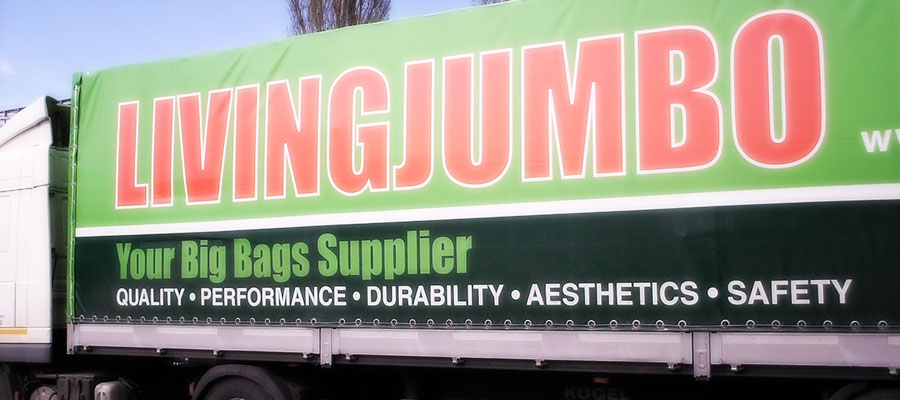
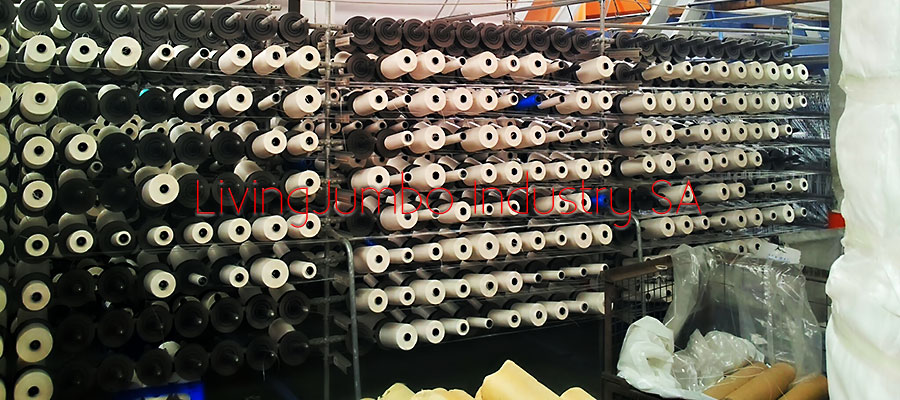
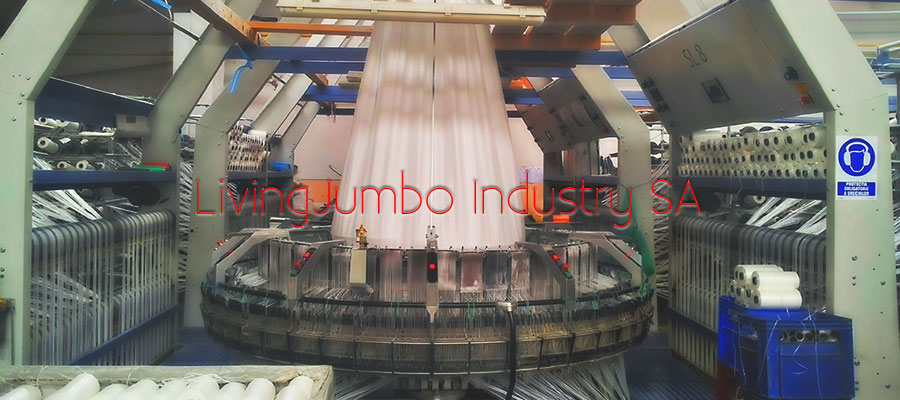
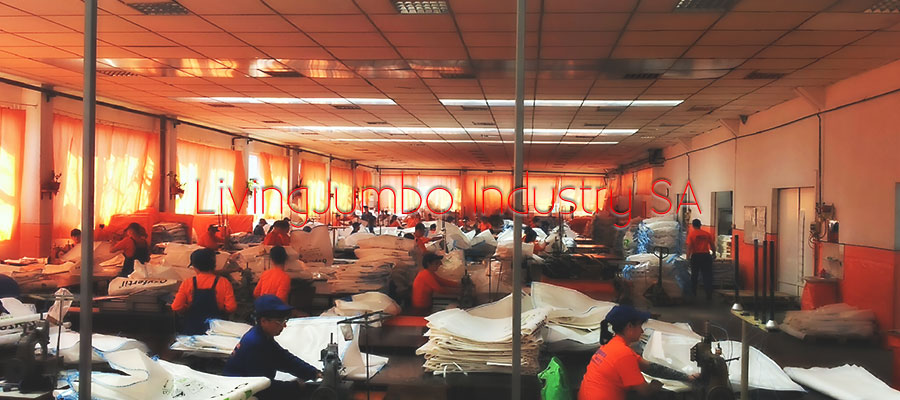
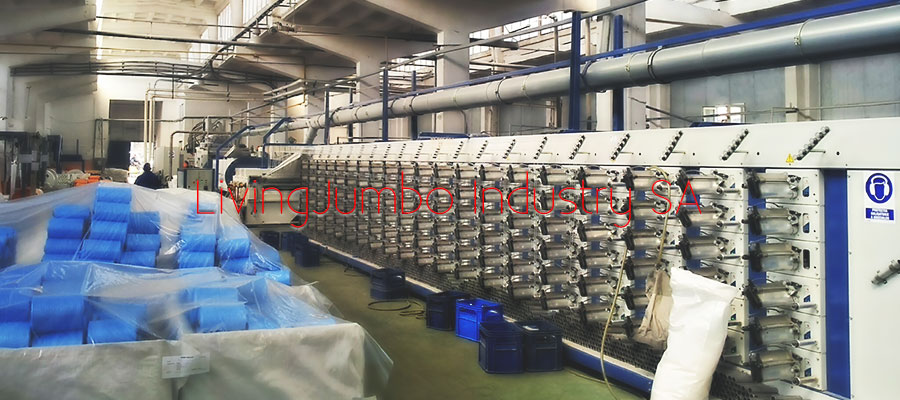
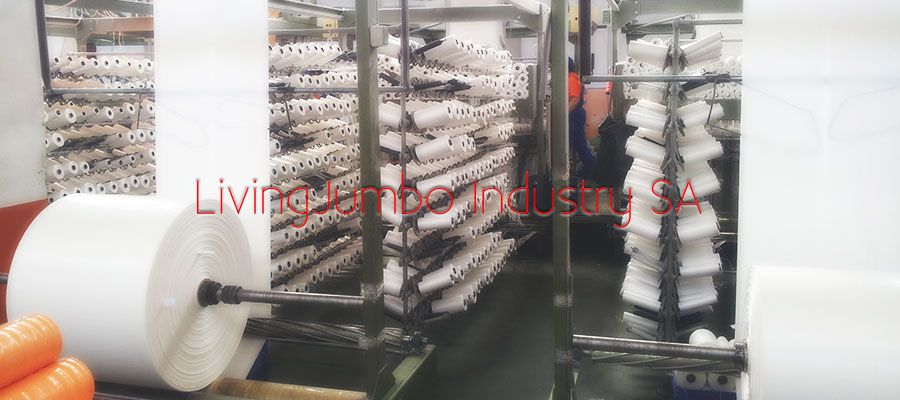
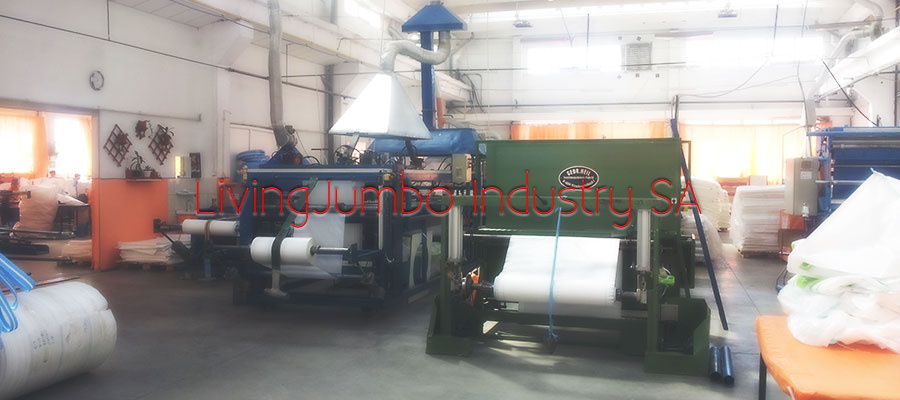
Sacii tip big bags din polipropilena (PP) - cunoscuti ca si "FIBCs", "bulk bags", "jumbo bags" - sunt definiti ca si containere mari construite din corpuri executate din tesatura flexibila cu scopul transportului si depozitarii marfurilor vrac.
Fabricati in mod uzual din tesatura PP laminata sau nelaminata, sacii tip big bags sunt executati din tesaturi diferite, cu greutati diferite in functie de capacitatea de incarcare si factorul de siguranta al containerului.
Big bags-urile din polipropilena nu necesita o ambalare ulterioara intrucat sunt proiectati pentru a fi ridicati de partea de sus folosind dispozitive special atasate: chingi (manere) din polipropilena.
Avand in vedere faptul ca marfurile vrac sunt de diferite tipuri, acestea solicita diferite solutii de ambalare - incepand de la proiectare, planificare, constructie, pana la asamblare, ambalare, transport stocare si asistenta - producatorii de big bags dezvolta o varietate de posibilitati de ambalare pentru oferirea celei mai bune solutii clientilor.
In aceste conditii, in loc sa fie blocati de alegerea unor containere rigide care limiteaza posibilitatile de incarcare, manipulare, stocare si descarcare a produselor, din ce in ce mai multe companii aleg sa foloseasca sacii tip big bags executati in conformitate cu nevoile specifice fiecarei entitati.
Alte avantaje rezultate din folosirea sacilor big bags din polipropilena:
flexibilitatea design-ului (varietate de dimensiuni, solutii de incarcare/descarcare, imprimare, etichetare, etc);
guri speciale atasate la capacul si la fundul sacilor pemit o mai mare acuratete in timpul incarcarii si amestecarii produselor vrac. Aceasta facilitate asigura de asemenea o mai usoara executie a operatiunilor de pornire/oprire in timpul incarcarii si descarcarii;
varietatea de tesaturi de polipropilena - circulare sau plane - folosite la fabricarea formelor tubulare sau patrate ale corpurilor permit alegerea celei mai bune solutii de transportare, manipulare si depozitare a marfurilor;
posibilitatea producerii de saci big bags din tesatura anti-statica - astfel sacul nu mai necesita impamantare (respectarea standardelor tip C si D referitoare la controlul descarcarilor statice);
big bags-urile din polipropilena sunt mai sigure de utilizat multumita faptului ca nu exista probleme de scurgere a materialelor sau contaminare cu praf, sacii fiind adaptabili pentru toti utilizatorii;
PP big bags special conceputi, cu insertie de polietilena - huse PE - pot fi utilizati pentru protectia impotriva umezelii. Acest tip de saci au rolul de a evita/preveni miscarea in timpul umplerii sau golirii, asigurand totodata pierderile/scurgerile de material prin tesatura. De asemenea, asigura protectia materialelor higroscopice ambalate in sacii de tip big bags fata de umiditatea mediului inconjurator (ex. sare, ingrasaminte);
acesti saci au o gama larga de aplicatii practice, cum ar fi ambalarea unor produse ca: aliaje de fier, chimicale, praf de piatra, nisip, pietris, ciment, alimente (zahar, sare, faina, dextroza, amidon, aditivi), ceramic, argila, var (nestins), cauciuc, negru de fum, agricultura (seminte, grau, porumb, fasole boabe), minereuri, etc;
fabricati din tesatura laminata sau nelaminata, sacii tip big bags sunt UV stabilizati pentru protectia impotriva radiatiilor solare;
sacii big bags sunt usor de reciclat, ajutand in acest fel la protejarea mediului;
popularitatea acestor saci se datoreaza si reducerii costurilor cu manipularea, reducerea potentialelor pierderi la client precum si compatibilitatii cu transportul cu camioane sau containere.
Livingjumbo Industry S.A. produce si comercializeaza:
fir PP (pentru tesatura PP, dimensiuni intre 1100-4500 DEN);
ata PP (pentru cusut, dimensiuni intre 3-4 mm);
siret PP (dimensiuni intre 10-30 mm);
chinga PP (dimensiuni intre 40-60 mm);
tesatura PP (cu greutate intre 95-220 g/m2), circulara sau plana (dimensiuni intre 1000-4200 mm);
saci tip big bags PP (FIBCs, bulk bags, jumbo bags) cu 1, 2 sau 4 manere, cu guri de incarcare/descarcare, cu fusta la gura, fabricate din tesatura circulara sau plana, laminata sau nelaminata, cu sau fara husa PE, imprimati sau neimprimati, pentru capacitati cuprinse intre 250-1800 kg, intr-o varietate de marimi si forme, pentru o varietate de aplicatii;
prelate PP.
Este general acceptat faptul ca sacii tip big bags (FIBCs, bulk bags or jumbo bags) reprezinta una dintre cele mai rentabile si ideale solutii de ambalare in vederea manipularii si depozitarii produselor vrac.
Containerele flexibile din polipropilena se prezinta intr-o gama larga de variante constructive, design-ul lor fiind destinat sa satisfaca cerintele utilizatorilor.
Cele mai cunoscute sunt tipurile STANDARD de big bags cu 1, 2 sau 4 manere.
Dimensiunile acestora si caracteristicile suplimentare variaza in principal in functie de capacitatea de incarcare, factorul de siguranta si de destinatia sacilor.
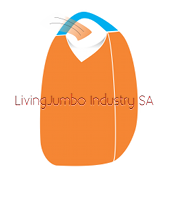
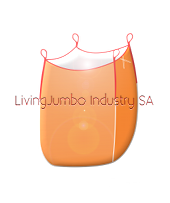
BIG BAGS-urile cu 1 (un) maner pot fi:
simplu indoite la fund;
simplu indoite la fund cu gura de evacuare;
fund plat;
fund plat si gura de alimentare;
fund plat cu guri de alimentare si evacuare;
fund conic.
click
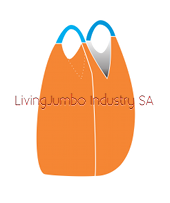
BIG BAGS-urile cu 2 (doua) manere pot fi:
simplu indoite la fund;
simplu indoite la fund cu gura de alimentare;
fund plat;
fund plat cu gura de alimentare;
fund plat cu guri de alimentare si evacuare;
fund conic.
click
BIG BAGS-urile cu 4 (patru) manere pot fi:
gura deschisa si fund plat;
fusta la gura si fund plat;
fusta la gura si gura de evacuare;
gura deschisa si gura de evacuare;
gura de alimentare si fund plat;
guri de alimentare si evacuare;
guri de alimentare si evacure cu capison.
click
Livingjumbo Industry S.A. produce si saci tip Q bags ("baffle bags"), cu 4 sau 5 pereti interiori, construiti in general din tesatura PP laminata cu snur anti-praf (DSP). Q bags-urile sunt fabricate in scopul formei initiale - relativ cubica - atunci cand materialele sunt incarcate, eliminand in acest mod rotunjirea formei ambalajelor standard. Sunt utilizati in principal pentru ambalarea materialelor care au tendinta de a deforma sacii si care ar ingreuna manipularea acestora (grafit, cereale, fibra de sticla, funingine, etc). De asemenea, printre avantajele utilizarii Q bags-urilor trebuie mentionat faptul ca acestia ocupa un spatiu de depozitare mai mic, si, foarte important, reducerea costurilor de transport.
Un alt tip de big bags produs si comercializat de compania noastra este utilizat pentru manipularea si stocarea marfurilor cu caracteristici speciale, care fac dificila operatiunea de descarcare completa. Acesti saci sunt big bags-urile conice folosite pentru ambalarea produselor specifice, cum ar fi: coloranti, pigmenti, pudra alimentara, etc.
Livingjumbo Industry S.A. produce de asemenea UN big bags, containere folosite pentru transportul, manipularea si depozitarea produselor periculoase si a deseurilor toxice. UN big bags sunt confectionate in concordanta cu Recomandarile Natiunilor (United Nations Recommendations) referitoare la Transportul Produselor Periculoase (Orange Book): rutier (ADR), feroviar (RID) si maritim (IMDG - Code). Compania noastra detine certificate in vederea producerii UN big bags cod Y - containere flexibile aprobate pentru ambalare grupa II, clasa 5.1 - "Substante oxidante".
PRIMUL PAS: CONTACTUL CU LIVINGJUMBO INDUSTRY S.A.
Pentru a beneficia de saci tip big bags de cea mai buna calitate primul pas il reprezinta contactul cu compania noastra.
Odata contactul fiind stabilit, restul depinde de specialistii nostri care, in functie de specificul activitatii dvs, se vor asigura ca veti primi cea mai buna solutie legata de ambalare. Aceasta va marca de asemenea inceputul unei cooperari productive pe termen lung.
PASUL DOI: PROCESUL DE DESIGN AL SACILOR BIG BAGS
Eforturile noastre sunt indreptate atat in directia respectarii specificatiilor tehnice, cat si in ceea ce priveste aspectul estetic.
Legat de designul big bags-urilor va putem asigura de faptul ca Livingjumbo Industry S.A. va lua toate masurile necesare pentru a va livra acel specific tip de big bags care va elimina problema ambalarii de pe agenda dvs.
Este sarcina noastra sa oferim clientilor forma constructiva adecvata cu detalii asimilate: tesatura, chinga, ata de cusut, siretul din polipropilena de cea mai buna calitate, alaturi de optiunile legate de: coasere, imprimare, etichetare corespunzatoare.
PASUL TREI: PROCESUL PROPRIU ZIS DE PRODUCTIE
In urma stabilirii tuturor aspectelor legate de constructia big bags-urilor, pasul firesc de indeplinit este fabricarea propriu zisa a materialelor care intra in componenta acestora.
Principalul motiv pentru care garantam si recomandam produsele noastre este cel potrivit caruia personalul nostru supervizeaza intregul lant de productie, evitand aparitia si propagarea vreunei erori umane sau materiale.
Indiferent ca este vorba despre: fir PP; tesatura PP; chinga PP; ata de cusut PP; siret PP sau sfoara PP compania noastra va asigura ca toate materiile prime si materialele sunt fabricate in sectiile noastre de productie. Astfel, nu numai ca ne autointitulam "furnizorul dvs de big bags", dar suntem si noi, in acelasi timp clienti pentru furnizorii de granule de polipropilena si polietilena, huse de polietilena, cerneluri, coloranti, si alte materii prime.
Aflandu-ne ca si dvs in postura de clienti, suntem deci constienti de importanta dimensiunii calitatii produselor aprovizionate si a implicatiilor sale in desfasurarea continua si cu succes a activitatii firmei.
In cadrul procesului de fabricatie Livingjumbo Industry S.A. aduce la numitor comun 3 (trei) componente esentiale, si anume: omul, masina si bineinteles, produsul.
Combinatia realizata la cel mai inalt nivel de responsabilitate si calitate a muncii reuseste sa asigure productia si livrarea de big bags-uri indispensabile pentru siguranta afacerii dvs.
PASUL PATRU: LIVRARE - INAINTE SI DUPA
In afara de calitatea produselor comercializate, ne preocupam permanent de supervizarea intervalului de timp scurs intre momentul in care clientii iau legatura cu specialistii nostri si momentul livrarii marfurilor.
Aceasta activitate este indreptata in scopul servirii acelor clienti care prefera sa isi mentina stocurile la un nivel minim sau egal cu zero (livrari JIT "just-in-time"), beneficiind de avantajul pozitiei geografice si de legaturile excelente cu infrastructurile de transport si alte servicii asimilate.
Dupa cum am mentionat in "Cartea de vizita" a companiei, in conformitate cu Sistemul Managementului de Calitate, Livingjumbo Industry S.A. asigura:
asistenta acordata clientilor;
rezolvarea posibilelor neconformitati;
verificarea nivelului de satisfactie al clientilor (prin chestionare transmise periodic acestora in scopul preintampinarii unei lipse de comunicare si mai ales in vederea imbunatatirii competitivitatii pe piata specifica).
In concluzie, Livingjumbo Industry S.A. se numara printre companiile de elita in domeniul producerii sacilor tip big bags intrucat, indiferent ca ne referim la experienta angajatilor, performantele echipamentelor de lucru sau calitatea produselor finite, avem in vedere atributele principale ale succesului:
performanta;
siguranta;
conformitate;
incredere;
durabilitate;
estetica.
Imprimare
In cadrul proceselor de fabricatie desfasurate in Livingjumbo Industry S.A. big bag-urile pot fi imprimate cu un maxim de 3 culori/1 fata (insemnand maxim 6 culori/2 fete) la o singura trecere prin masina de imprimare.
Indiferent daca partenerii ne furnizeaza sablonul de imprimare in format digital-vectorial sau nu (fisier .cdr sau .jpeg) - ori sub forma unei schite executate manual, specialistii nostri sunt pregatiti sa ofere asistenta de specialitate in vederea intocmirii "desenului" in format profesional.
Ca si regula generala, macheta/sablonul de imprimat este trimis la client in vederea aprobarii, urmand ca apoi sa intre in faza de executie a comenzii.
Tehnologia folosita de catre LIVINGJUMBO INDUSTRY pentru imprimarea sacilor big bags este imprimarea flexografica, materialele utilizate fiind de o calitate ireprosabila pentru obtinerea rezultatelor scontate si avand toate avizele necesare pentru utilizarea lor in siguranta si cu respectarea normelor de protectie a mediului.
Etichetare
La livrare, fiecare sac este prevazut cu o ETICHETA care cuprinde:
instructiuni de manipulare;
sarcina/capacitatea de incarcare (SWL = Safe Working Load);
factorul de siguranta (SF = Safety Factor);
numarul certificatului emis de catre Institutul German Labordata (daca este cazul).
Eticheta poate avea caracter neutru sau poate contine emblema companiei noastre, pe baza cererii clientului. Ca si pozitie de amplasare, eticheta poate fi introdusa intr-o punguta cu fermoar, imprimata sau cusuta pe big bags.
De asemenea, sacii nostri pot fi prevazuti cu "buzunar de documente" (la cerere) utilizat de catre client in scopul introducerii etichetei proprii cu detalii legate de marfurile ambalate.
Documente ce insotesc sacii big bags:
factura comerciala;
packing - list (in cazul livrarilor externe);
certificat de origine (daca este cazul);
CMR (in cazul livrarilor externe);
certificat de calitate;
declaratie de conformitate.
PIATA INTERNA
Scopul nostru in ceea ce priveste livrarile de big bags pe plan intern este acela de a ajunge la client printr-un contact direct, indiferent de domeniul in care activeaza acesta (industria alimentara, chimica, reciclarii, etc).
Intrucat tipologia de saci big bags este variata, nu sunt rare cazurile in care ne indrumam clientii in vederea alegerii celei mai bune solutii de ambalare pentru afacerea lor.
In acest mod, ca si producator de elita in domeniu, Livingjumbo Industry S.A. isi ajuta partenerii sa reduca nivelul costurilor, adoptand solutii specifice destinatiei sacilor big bags.
Din moment ce mentinem un contact permanent si apropiat cu clientii nostri - existenti si potentiali - celelalte canale de distributie sunt mai putin utilizate pe plan intern, desi nu sunt excluse.
Dovedim astfel ca Livingjumbo Industry S.A. este o companie deschisa oportunitatilor productive de afaceri, indreptandu-si toate eforturile in directia satisfacerii depline a cerintelor clientilor sai.
PIATA EXTERNA
In scopul livrarii produselor noastre utilizam diverse canale de distributie:
direct la utilizatorii finali;
prin intermediul comisionarilor;
prin intermediul companiilor/camerelor de distributie/comert.
Indiferent de canalul de distributie folosit, Livingjumbo Industry S.A. asigura atat calitatea produselor sale, cat si livrarea rapida - abilitati care ne permit mentinerea si chiar cresterea cotei de piata si a portofoliului de clienti.
In acest mod sacii nostri big bags sunt prezenti pe piete de desfacere dintre cele mai exigente care solicita caracteristici constructive diverse, imprimari speciale, etc, in tari ca: Olanda, Belgia, Franta, Germania, Italia, Spania, Norvegia, Bulgaria, Iugoslavia, Rep. Moldova s.a.m.d.
Livingjumbo Industry S.A. poate asigura o comunicare rapida si coerenta in diferite limbi de circulatie: Engleza, Franceza, Germana, Italiana, Spaniola (fiecare cerere de oferta primeste raspunsul nostru in cateva ore, iar in cazuri exceptionale in maxim 24 de ore).
De ce LIVINGJUMBO INDUSTRY?
Pentru ca suntem deplin convinsi ca cel mai important actionar al companiei noastre este CLIENTUL.
De aceea, noi oferim:
cea mai buna calitate a materiilor prime, materialelor si a produselor finite;
livrari in sistem JIT ("just-in-time") in scopul mentinerii la un nivel minim sau zero al stocurilor cu respectarea sistemului trasabilitatii produselor;
asistenta in vederea gasirii celor mai bune solutii si a mentinerii unui parteneriat de succes;
flexibilitate de executie in functie de necesitati;
permanenta preocupare pentru dezvoltare prin implementarea Sistemelor de Management al Calitatii ISO 9001, al Mediului ISO 14001 si Siguranta a Produselor Alimentare HACCP-ISO22000, achizitii de tehnologii performante si perfectionarea continua a personalului.
Pentru ca intotdeauna indeplinim si chiar depasim asteptarile Dumneavoastra legate de solutiile de ambalare pe care ni le solicitati.
I. SACI TIP BIG BAGS
Tipuri constructive
1, 2 sau 4 manere (de sustinere);
la sacii cu 1 si 2 manere, manerele sunt formate prin constructie din corpul sacilor (vezi cod produs: 1LJI_A si B, 2LJI_A si B);
in cazul sacilor cu 4 manere (vezi cod produs: 4LJI_A …4LJI_F, QLJI_A si QLJI_B) chingile de ridicare (sustinere si manipulare) sunt confectionate separat, prin tesere, din fire de polipropilena (vezi cod produs: 7LJI_40 pana la 7LJI_70).
Tesatura
tesatura fabricata din granule de polipropilena cu stabilizare U.V;
circulara sau plana, in functie de tipul sacilor big bags (vezi cod produs: 6LJI_1000 pana la 6LJI_4000).
Aditional
tesatura poate fi laminata - in functie de produsul de ambalat;
posibilitate insertie (la interior) huse polietilena pentru a evita scurgerea/pierderea materialului ambalat.
Caracteristici speciale
imprimare flexografica pe corpul sacului - logo client;
coasere cu snur antipraf pentru a evita scurgerea/pierderea materialului ambalat;
aplicare eticheta cu instructiuni de manipulare si buzunar de documente, in functie de cerintele clientului.
Sarcina de incarcare (SWL=Safe Working Load)
250 – 2000 kg.
Factor de siguranta (SF =Safety Factor)
5:1 - pentru ambalare materiale nepericuloase (o singura utilizare - Single-Trip use);
6:1 - pentru ambalare materiale periculoase (mai multe utilizari - Multi-Trip use).
Domenii de utilizare
agricultura (seminte, cereale, furaje);
industria alimentara (pulberi si produse granulare - sare, zahar, orez, lapte praf, etc);
industria chimica (soda, uree, azotat de amoniu, ingrasaminte, etc);
materiale de constructii (nisip, var, ciment, pietris, moloz, etc);
industria de prelucrare a lemnului (deseuri de lemn, rumegus, peleti, brichete);
colectare, valorificare si reciclare deseuri (feroase, neferoase, lemn, plastic, PVC, PET, PE, PP, etc).
II. ALTE PRODUSE
fir polipropilena 1000 - 4500 DEN (vezi cod produs: 5LJI_1000 pana la 5LJI_4500);
tesatura polipropilena 1000 - 4000 mm/95 - 200 gr (vezi cod produs: 6LJI_1000 pana la 6LJI_4000);
chinga polipropilena 40 - 70 mm (vezi cod produs: 7LJI_40 pana la 7LJI_70);
ata polipropilena 4500 DEN (vezi cod produs: 8LJI_4500);
siret polipropilena 10 - 30 mm (vezi cod produs: 9LJI_10 pana la 9LJI_30);
sfoara polipropilena 3 - 4 mm (vezi cod produs: 10LJI_4500).
| Categorii produse | Caracteristici | Cod | Model |
| Big bags cu 1 maner Huse PE la interior |
Fund plat | 1LJI_A | |
| Big bags cu 1 maner Huse PE la interior |
Gura de evacuare | 1LJI_B | 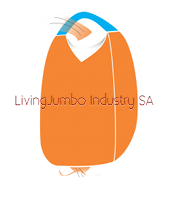 |
| Big bags cu 2 manere Huse PE la interior |
Fund plat | 2LJI_A | |
| Big bags cu 2 manere Huse PE la interior |
Gura de evacuare | 2LJI_B | 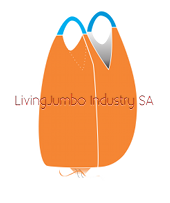 |
| Big bags cu 4 manere | Gura deschisa si fund plat | 4LJI_A | 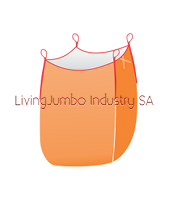 |
| Big bags cu 4 manere | Gura de alimentare si fund plat | 4LJI_B | 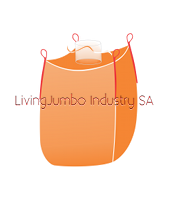 |
| Big bags cu 4 manere | Gura deschisa si gura de evacuare | 4LJI_C | 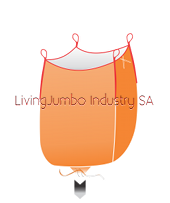 |
| Big bags cu 4 manere | Gura de alimentare si evacuare | 4LJI_D | 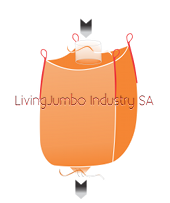 |
| Big bags cu 4 manere | Fusta la gura si fund plat | 4LJI_E | 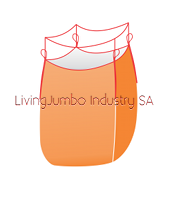 |
| Big bags cu 4 manere | Fusta la gura si gura de evacuare | 4LJI_F | 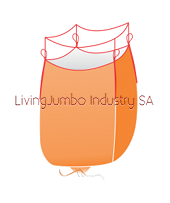 |
| Q bag – big bags cu 4 manere si pereti interiori | Gura de alimentare si fund plat | QLJI_A | 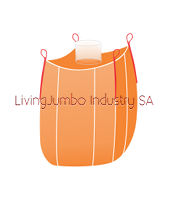 |
| Q bag – big bags cu 4 manere si pereti interiori | Gura de alimentare si evacuare | QLJI_B | 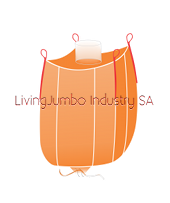 |
| Fir polipropilena | 1000 - 4500 DEN | 5LJI_1000 ... 5LJI_4500 | 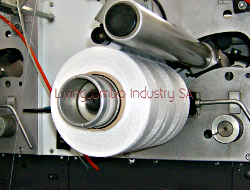 |
| Tesatura polipropilena Plana/circulara Laminata/nelaminata |
latime: 1000 - 4000mm gramaj: 95 - 200 gr/m2 |
6LJI_1000 ... 6LJI_4000 | 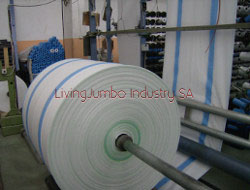 |
| Chinga polipropilena | 40 - 70 mm | 7LJI_40 ... 7LJI_70 | .jpg) |
| Ata polipropilena | 4500 DEN | 8LJI_4500 | 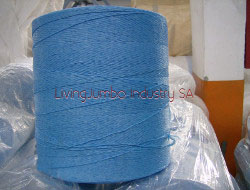 |
| Siret polipropilena | 10 - 30 mm | 9LJI_10 9LJI_15 ... | 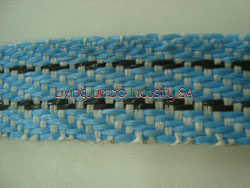 |
| Sfoara polipropilena | 3 - 4 mm | 10LJI_4500 | 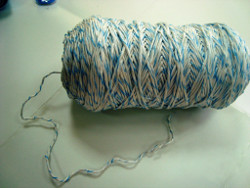 |
Pentru informatii suplimentare vizitati site-ul nostru www.livingjumbo.ro sau trimiteti-ne intrebarile Dvs. pe adresa de e-mail office@livingjmbo.ro.
Daca sunteti in trecere prin Buzau, vizitati-ne la sediul nostru din Str. Transilvaniei 132 (incinta Romcarbon), iar consultantii nostri vor fi incantati sa va ajute sa gasiti solutia de ambalare cea mai potrivita pentru produsul Dvs.
De asemenea, va stam la dispozitie zilnic, de Luni pana Vineri, intre orele 8 – 17 si la telefon: +40 338 101.120 / +40 338 101.121 si fax: +40 338 101.122.
LIVINGJUMBO INDUSTRY S.A.
Strada Transilvaniei 132, Buzau, Romania
Telefon: +40 338 101.120 / 21, Fax: +40 338 101.122
office@livingjumbo.ro
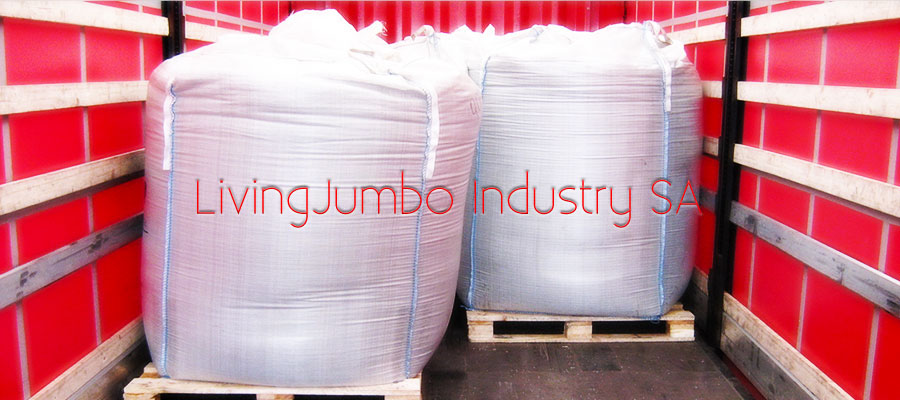
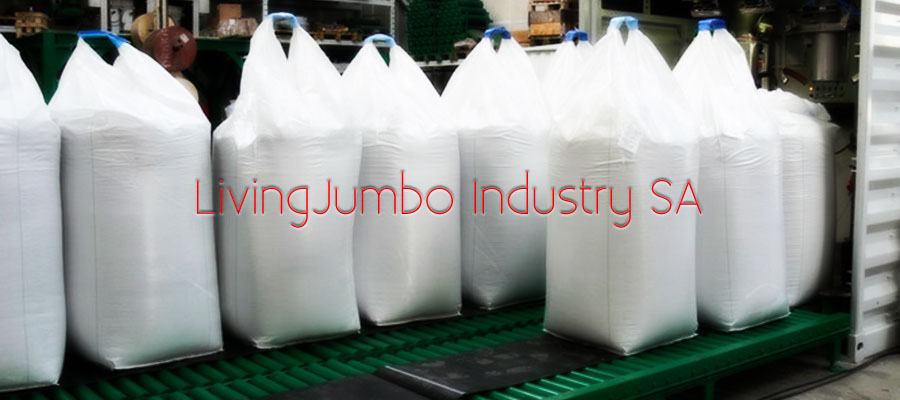
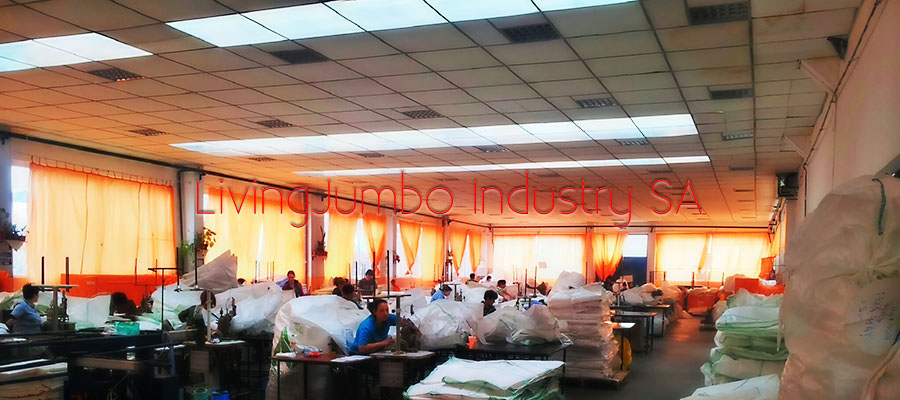
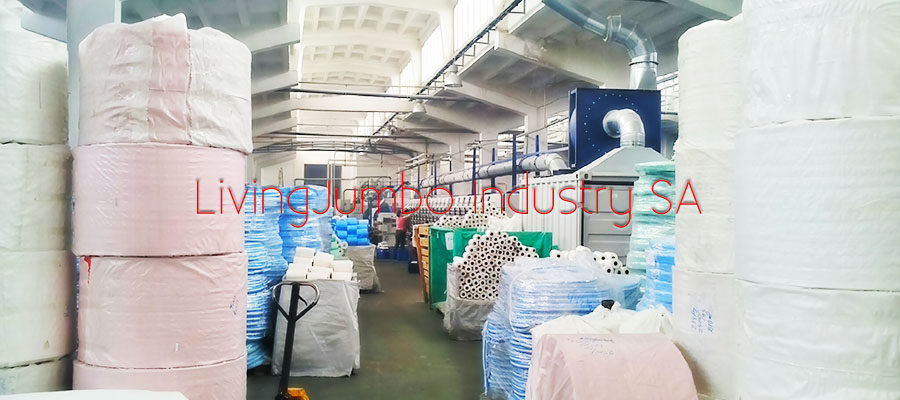
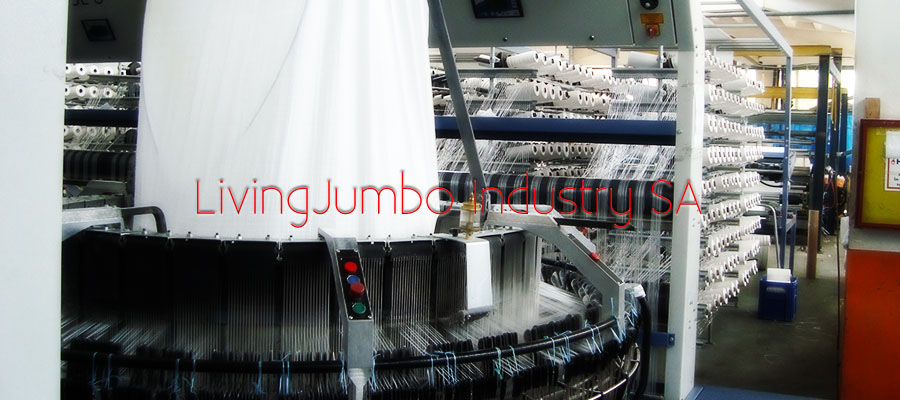
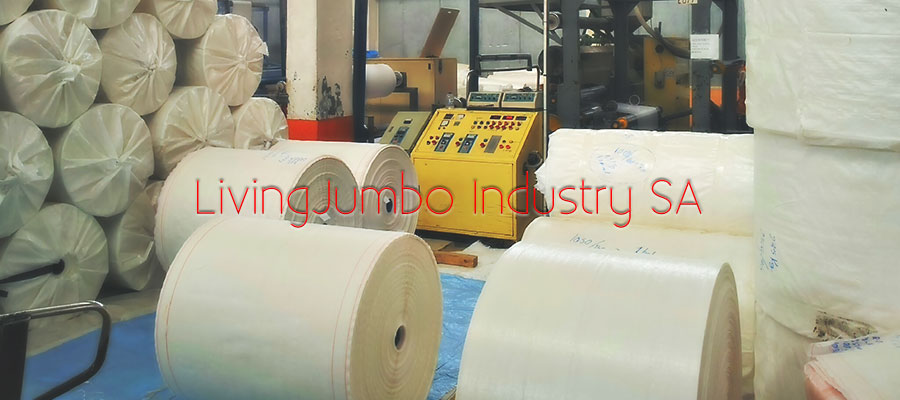
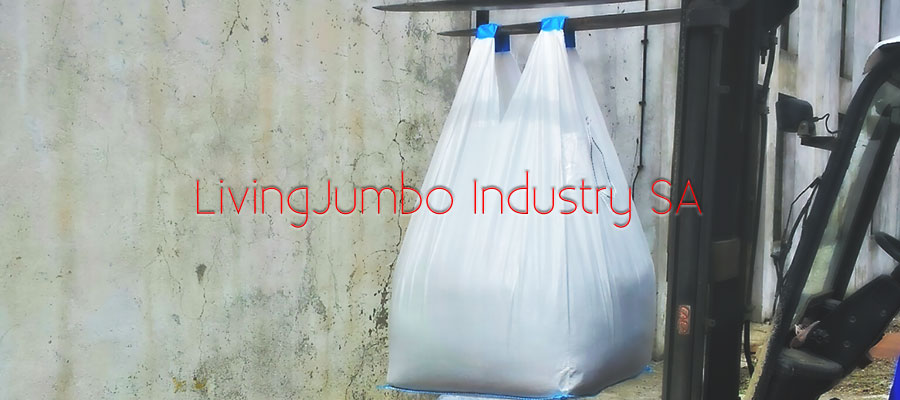
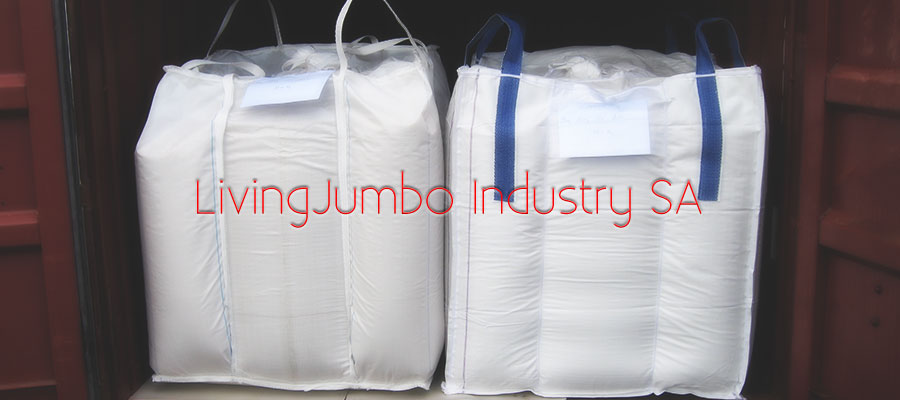
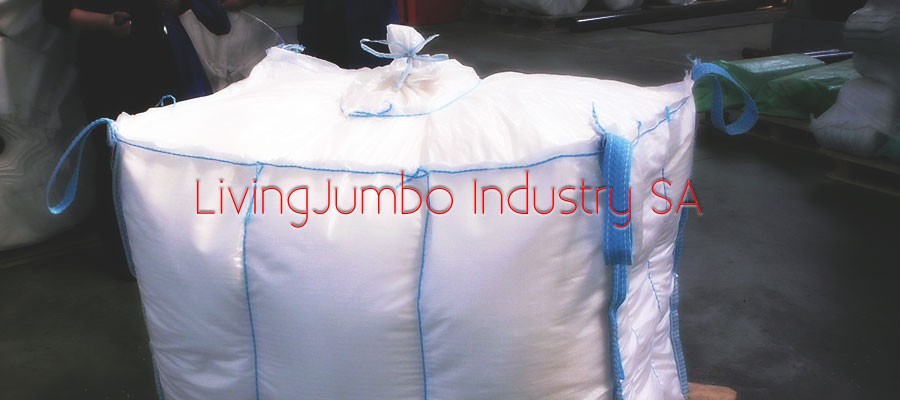
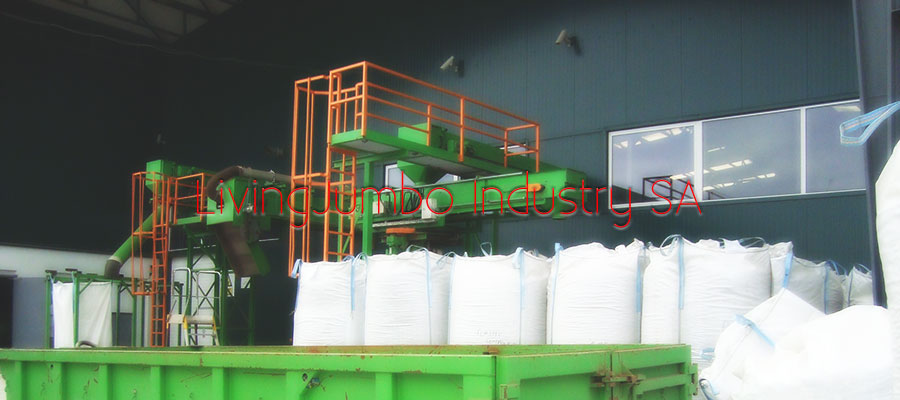
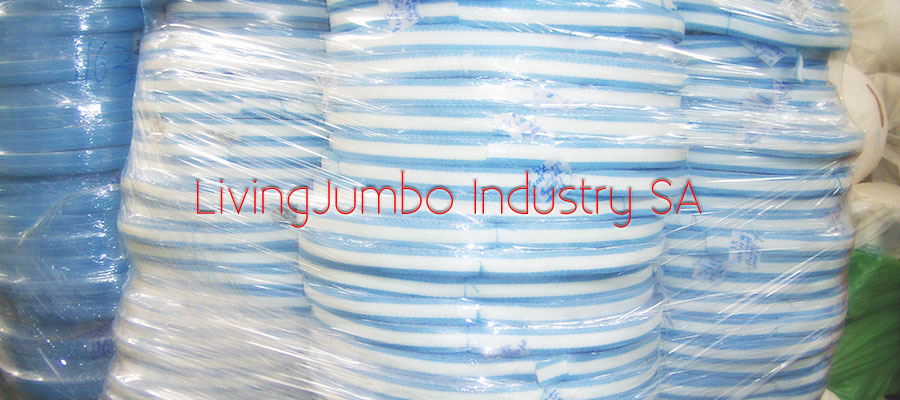
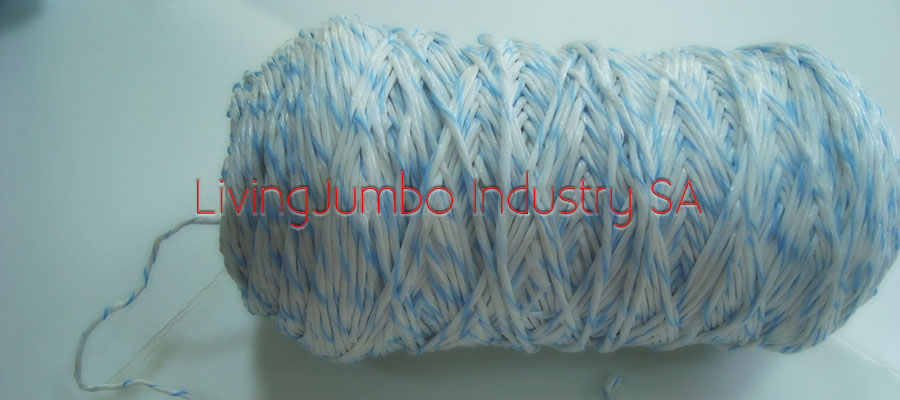
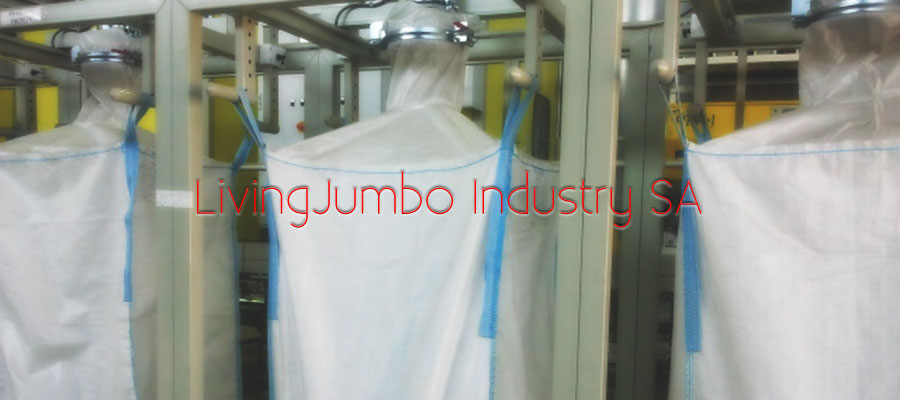
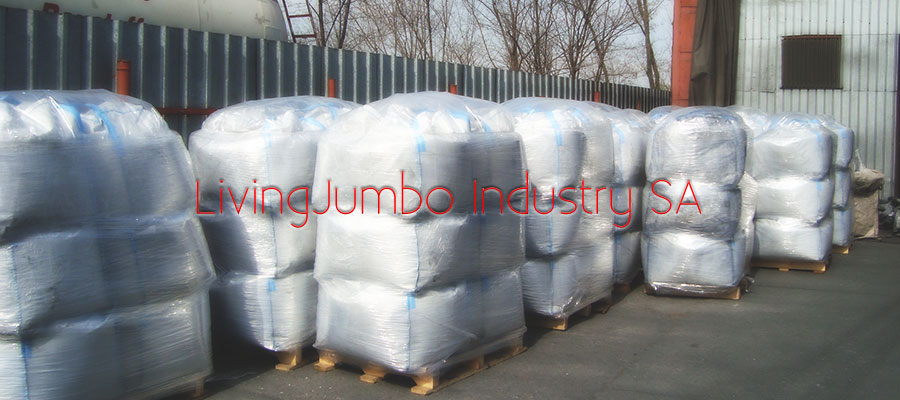
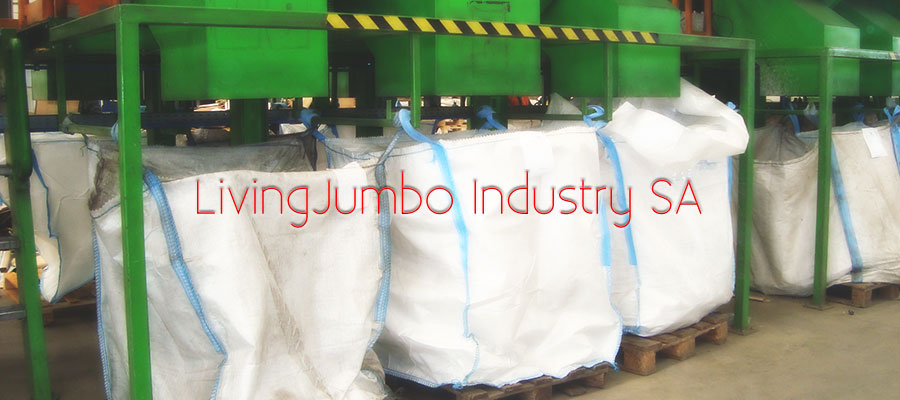
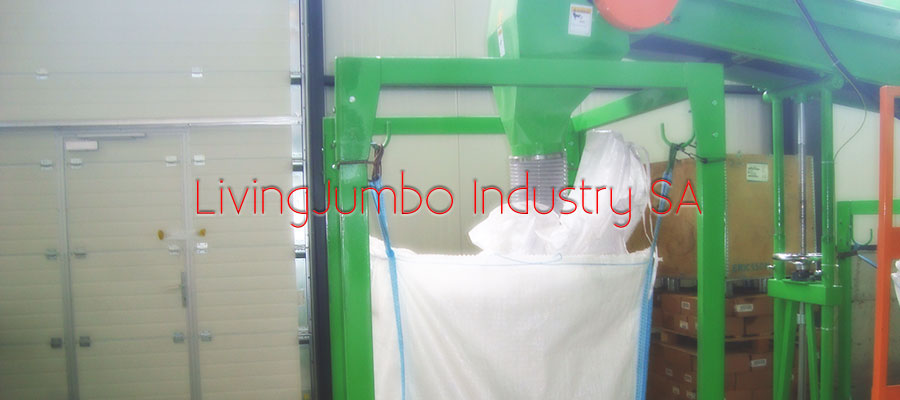
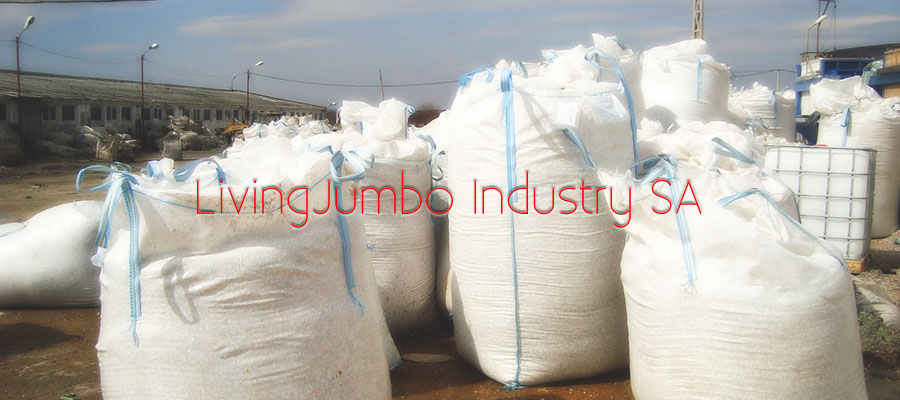
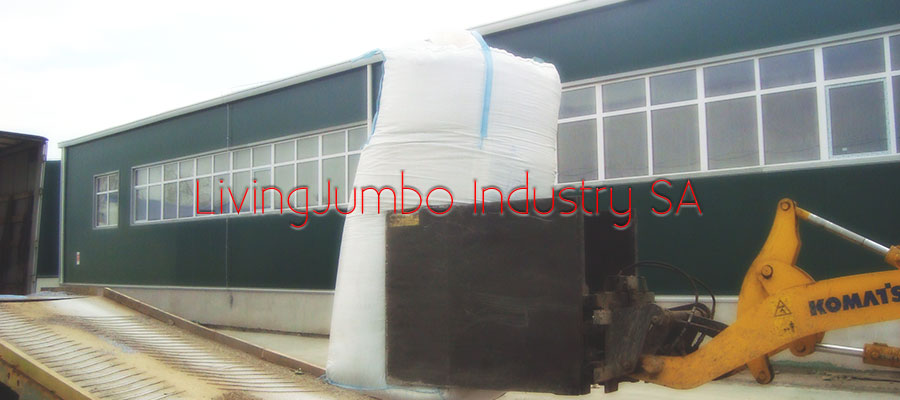
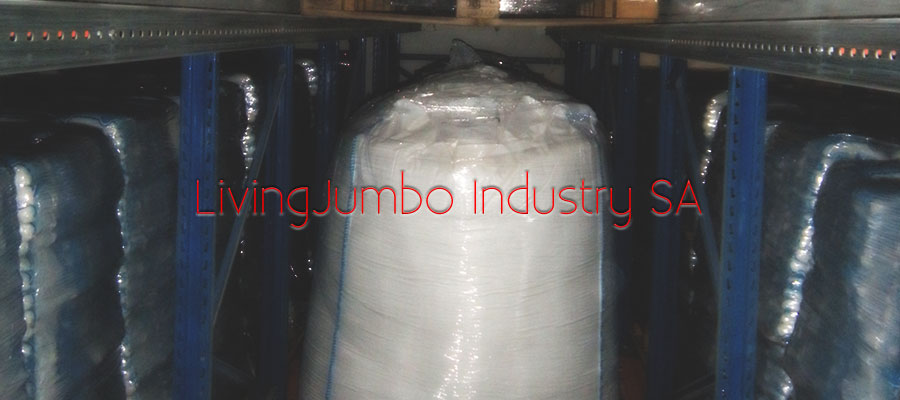
In primul rand Livingjumbo Industry S.A. realizeaza un CONTROL RIGUROS AL MATERIILOR PRIME si anume:
calitatea granulelor de polipropilena (PP) si polietilena (PE);
latimea si grosimea (finetea) firului PP;
rezistenta UV (rezistenta la rupere si alungire) dupa expunerea fortata la radiatii in laboratorul propriu;
rezistenta firelor in urzeala si in batatura;
densitatea de tesere;
rezistenta tesaturii si a chingilor (manerelor) PP;
calitatea atei de cusut si a sforii PP;
factori de siguranta (5:1 si 6:1).
verificarea nivelului de contaminare al sacilor nostri este asigurata de catre Institutul de Bioresurse Alimentare.
In al doilea rand, intregul personal al companiei este foarte bine instruit in vederea realizarii si a unui control concomitent executarii fiecarei faze a procesului de productie (de la obtinerea firului PP, ata, chinga, sfoara, siret, tesatura pana la operatiunile de imprimare, coasere, etichetare si impachetare in vederea livrarii).
In ultimul rand, dar nu mai putin important, trebuie mentionat controlul permanent realizat de catre personalul specializat (Control tehnic de Calitate) care monitorizeaza in mod constant atat performantele angajatilor, cat si productivitatea utilajelor in vederea evitarii producerii vreunei erori in lantul de productie.
Aprobarea finala pentru ca sacii big bags sa paraseasca fabrica este completata numai atunci cand exista certitudinea ca produsele finite au trecut prin toate fazele controlului calitatii.
Ca rezultat al implementarii Sistemului de Management al Calitatii in 2003, LIVINGJUMBO INDUSTRY S.A. monitorizeaza si inregistreaza productia pe durata intregului lant al procesului tehnologic, de la granulele de polipropilena pana la sacii big bags de polipropilena.
Regulamentul General al UE pentru Produse Alimentare defineste TRASABILITATEA ca fiind: "abilitatea de a localiza si urmari un aliment, un ingredient alimentar, o substanta care intra in contact cu produsele alimentare, etc, de-a lungul tuturor proceselor de productie, procesare si distributie".
Trasabilitatea este importanta in special pentru intregul lant alimentar, intrucat o mare parte din clientii nostri ambaleaza produse alimentare in saci tip big bags, insa importanta acesteia nu se rezuma doar la acest domeniu. Trasabilitatea se dovedeste utila pentru toti clientii nostri.
Caracteristicile sistemelor de trasabilitate:
identificarea unitatilor/loturilor de materii prime pana la produsele finite;
informatii stocate referitoare la momentul si locul deplasarii si/sau transformarii acestora;
existenta unui sistem care face legatura intre toate informatiile inregistrate.
In practica, sistemele de trasabilitate sunt inregistrari scrise definite prin proceduri care arata calea unei unitati (a unui lot) de produs sau ingrediente de la un furnizor (sau de la mai multi furnizori), prin toti pasii intermediari prin care se proceseaza si combina ingredientele in produsele noi rezultate. Aceste sisteme urmeaza calea de la utilizatorii intermediari pana la utilizatorul final, pe tot lantul de aprovizionare.
Sistemele de trasabilitate se bazeaza in mod critic pe procesul de inregistrare a informatiilor. Volumul de informatii implicat in sistemele de trasabilitate variaza si este dependent de natura produsului si tipul procesului de fabricatie, precum si de specificatiile clientului si de cerintele legale.
Mecanisme robuste sunt implementate pentru a facilita colectarea si autentificarea informatiilor, pentru a face posibila actualizarea lor si transmiterea lor pe intregul lant de aprovizionare. In unele cazuri, teste analitice sunt efectuate pentru a sustine si verifica sistemele de trasabilitate.
Clientii nostri au in special beneficii ascunse de pe urma trasabilitatii, de exemplu, obtinerea mai eficienta a sigurantei produsului si o crestere a eficacitatii in cazul rechemarii produselor in situatii de urgenta.
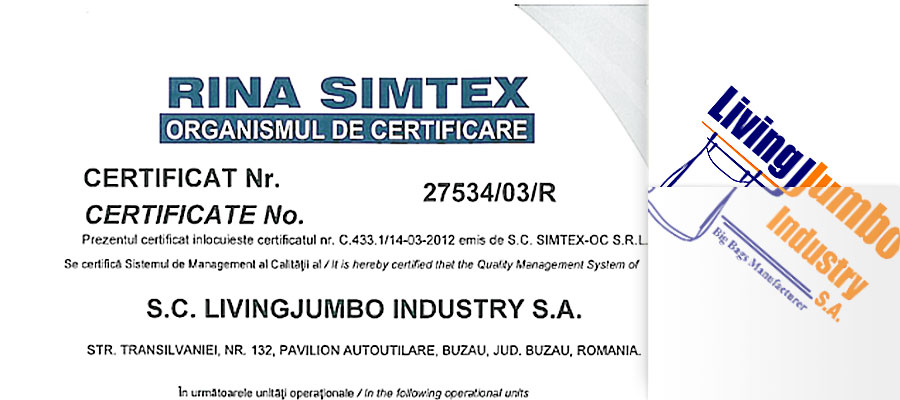

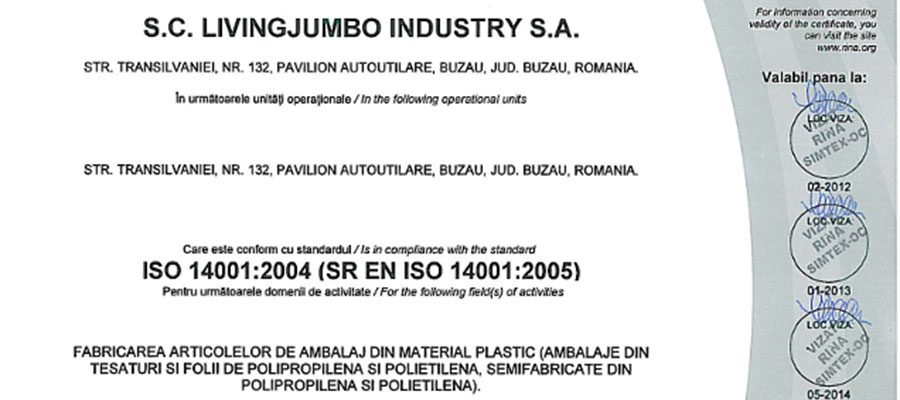
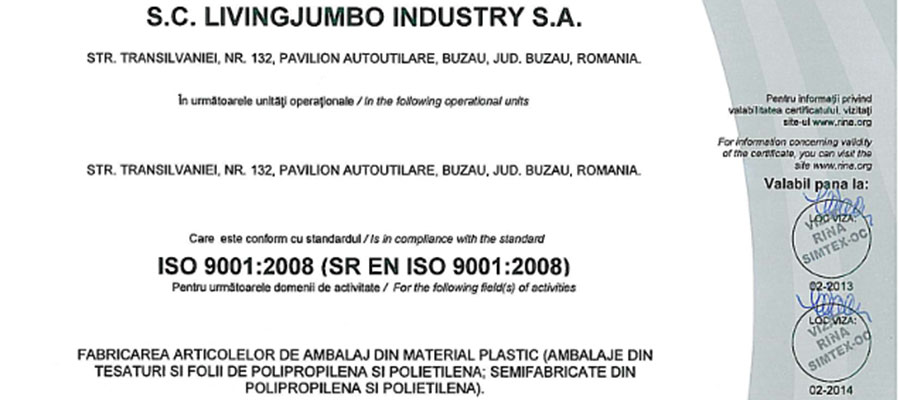
Protectia mediului
Toate activitatile care pot avea impact asupra mediului sunt perfect controlate, toti factorii de mediu (evacuarea apelor reziduale, gestionarea deseurilor, etc.) sunt monitorizati iar respectarea legislatiei de mediu este garantata prin existenta unor proceduri interne cunoscute si aplicate de intregul personal.
Puteti accesa urmatorul link pentru a citi Programul de prevenire si reducere a cantitatilor de deseuri generate
Protectia mediului
Toate activitatile care pot avea impact asupra mediului sunt perfect controlate, toti factorii de mediu (evacuarea apelor reziduale, gestionarea deseurilor, etc.) sunt monitorizati iar respectarea legislatiei de mediu este garantata prin existenta unor proceduri interne cunoscute si aplicate de intregul personal.
Puteti accesa urmatorul link pentru a citi Programul de prevenire si reducere a cantitatilor de deseuri generate
LIVINGJUMBO INDUSTRY SA a participat la cea de-a IV-a editie a Green Business Index (GBI), proiect multianual organizat de Asociatia Green Revolution in cadrul caruia au fost desemnate cele mai responsabile companii fata de mediu. Anul acesta au participat aproximativ 350 companii din segmentul de business local.
In cadrul acestei editii a GBI am avut onoarea sa primim premiul 2 la Categoria GBI Achizitii Verzi (industrie/productie).
Proiectul multianual GBI este singurul instrument gratuit de evaluare a responsabilitatii fata de mediu a companiilor din Romania conform standardelor ISO 14001 si ISO 14031, de monitorizare a initiativelor verzi din sectorul de afaceri romanesc si de asistenta si formare pentru îmbunatatirea performantei de mediu.
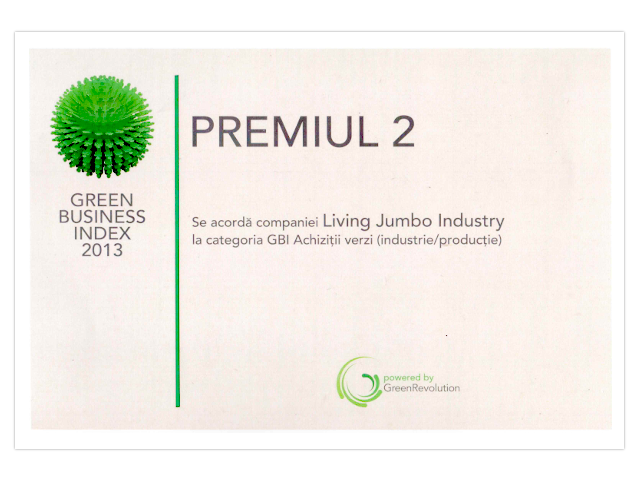
7 iulie 2013
Incepand cu 7 iulie va puteti bucura de un nou look pentru siteurile livingjumbo.ro si ambalaje-sacibigbags.ro.
Alaturi de noile elemente de grafica schimbarile sunt urmatoarele:
- integrarea unor galerii relevante pentru fiecare mare sectiune a siteului prezentata (ex. cine suntem - galerie cu imagini din fabrica, produse - galerie cu produsele oferite spre comercializare, contact - harta prezentand locatia google maps);
- incarcarea intr-o singura cerere a paginii web pentru intregul site astfel incat pentru navigare nu e nevoie sa mai asteptati deloc incarcarea si altor pagini;
- compresie sporita a tuturor elementelor siteului astfel incat timpul de incarcare al siteului sa fie minim;
- adaugare elemente dinamice site - ex. galeria foto fullscreen din pagina produse - descriere produse - click pentru fiecare categorie de produse, prezentarea evolutiei cursului valutar, prezentarea video, chestionarul cu criteriile pe care le considerati importante in achizitionarea sacilor big bags, animatiile cu sacii big bags din pagina produse - descriere produse, navigarea in meniul secundar, prezentarea certificatelor detinute de noi fiind unele dintre acestea;
- simplificarea meniului astfel incat sa aveti imediat idee unde va aflati in site si prezentarea cat mai concisa a continutului;
- mesaje clare traduse in fiecare limba de circulatie internationala pentru erorile aparute in formularul de contact, chestionarul priving achizitionarea sacilor big bags;
- incarcarea in background a majoritatii imaginilor siteului astfel incat dumneavoastra sa puteti naviga imediat in sectiunile acestuia fara a simti in vreun fel povara unei conexiuni mai lente la internet.
Pentru a imbunatati functionalitatea siteului si a il face cat mai usor de folosit a fost adaugata compatibilitatea cu clientii care nu au javascript activat insa din motive de prezentare unele elemente au fost ascunse acestora. La fel s-a renuntat si la compatibilitatea siteului cu clientii mai vechi de internet explorer versiunile 6 si 7 deoarece numarul mic de clienti care folosesc aceste browsere si numarul mare de buguri, lipsa suportului pentru cele mai noi standarde web precum si securitatea scazuta fac contraproductiva incercarea de a "masca" neajunsurile unor browsere lansate in 2001 (IE6) si 2006 (IE7). Daca folositi windows xp va sfatuim sa faceti update pentru internet explorer 8 care repara multe din neajunsurile browserelor internet explorer mai vechi.
24 noiembrie 2012
LIVINGJUMBO INDUSTRY SA a participat la cea de-a treia editie a Green Business Index (GBI), proiect multianual organizat de Asociatia Green Revolution in cadrul caruia au fost desemnate cele mai responsabile companii fata de mediu. Anul acesta numarul de companii inregistrate in GBI a depasit 300.
In cadrul acestei editii a GBI compania noastra, Livingjumbo Industry SA avut onoarea sa primeasca premiul 3 la Categoria GBI Achizitii Verzi (industrie/productie).
Proiectul multianual GBI este singurul instrument gratuit de evaluare a responsabilitatii fata de mediu a companiilor din Romania conform standardelor ISO 14001 si ISO 14031, de monitorizare a initiativelor verzi din sectorul de afaceri romanesc si de asistenta si formare pentru imbunatatirea performantei de mediu.
Livingjumbo Industry SA este singurul producator roman de saci big bags (FIBC, flexible intermediate containers, saci cu 1, 2, 4 manere, PP bags, saci mari din rafie) detinator al sistemului integrat de management Calitate – Mediu – Siguranta Alimentului.
14 Aprilie 2012
Producatorul Dvs. preferat de big bags va ureaza Paste Fericit!
22 decembrie 2011
Stimati clienti, stimati viitori clienti,
Fie ca ati cumparat de la noi big bags, sau doar chinga PP, poate tesatura sau sfoara de balotat, sau poate doar ata de cusut, fie ca veti cumpara de acum incolo aceste produse, noi va multumim pentru buna colaborare de pana acum si speram ca in 2012 sa fiti si mai multumiti de produsele si de asistenta tehnica pe care o acordam.
Fie ca sarbatoarea Craciunului sa va gaseasca sanatosi, voiosi si plini de speranta de mai bine pentru anul urmator!
Craciun Fericit si La Multi Ani 2012!!!
1 Decembrie 2010
Stimati vizitatori,
In cazul in care aveti de manipulat materiale tip vrac (materiale de constructii, cereale, legume, combustibili solizi etc) si doriti sa economisiti spatiu de depozitare si sa reduceti costurile de transport ale acestora, utilizarea sacilor BIG-BAG permitand transportul mai multor tipuri de materiale cu acelasi vehicol fara ca materialele sa se amestece intre ele, va recomandam sa utilizati saci Big-Bag, iar daca aveti si un utilaj tip incarcator frontal sau excavator cu masa proprie mai mare de patru tone, atunci va supunem atentiei INCARCATORUL DE SACI BIG-BAG, care este o inventie patentata in Olanda si comercializata de Komac Equipment S.A. din Tg. Secuiesc.
Utilizand incarcatorul nostru, veti beneficia atat de productivitate mare in incarcarea sacilor din gramezi (in medie 60 de saci/ora) cat si de reducerea costurilor cu personalul si cu alte utilaje ajutatoare.
Incarcatorul de saci este manevrat de un singur utilaj si deservit de o singura persoana, putand aseza sacii direct pe remorca cu ajutorul incarcatorului imediat dupa umplere.
Datorita randamentului mare de umplere al sacilor, incarcatorul de saci ofera un ajutor deosebit si autoritatilor locale in timpul calamitatilor naturale, cum sunt inundatiile, deoarece se pot amenaja stavilare robuste din saci BIG-BAG intr-un timp foarte scurt.
Pentru mai multe informatii despre incarcator, vizitati site-ul nostru www.komac.ro.
Va multumim anticipat!
Komac Equipment S.A. - Echipamente pentru utilaje de constructii si agricole
RO-525400 Tg. Secuiesc Tel.: 0267-364300 Mobil: 0745-202344 E-mail. info@komac.ro